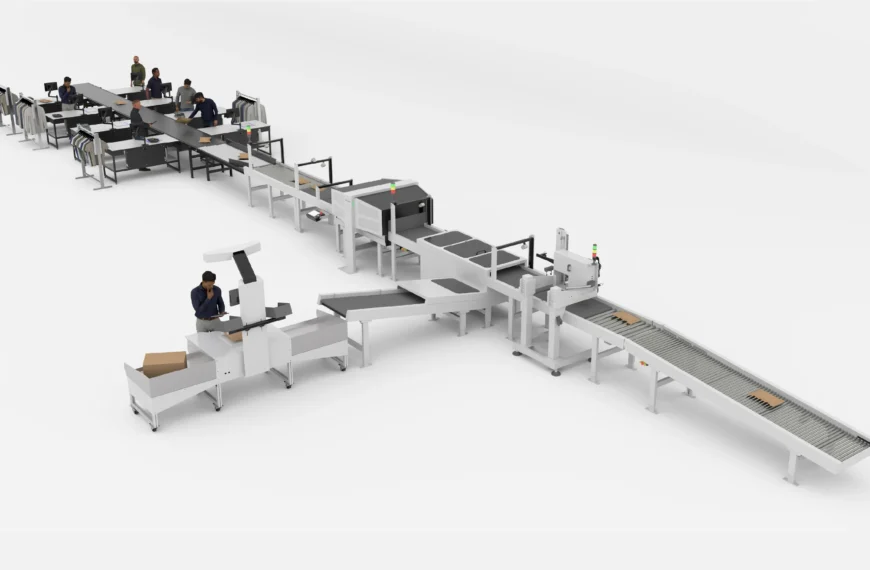


RFID testing solutions is the process that determines whether an RFID solution will perform reliably in production or create operational issues after deployment. While an RFID reader or tag may meet all technical specifications, factors such as materials, interference, product flow, and software integration can significantly affect real-world performance.
Deploying RFID without proper validation often leads to reading errors, loss of traceability, manual interventions, and unexpected costs. In contrast, a structured testing process helps identify risks before go-live and enables data-driven decision-making.
RFID testing is not about checking whether a tag can be read. It is about ensuring the entire solution performs consistently under real operating conditions.
Why testing RFID protects total cost, not just performance
Many RFID projects encounter challenges not because the hardware is inadequate, but because the solution was never validated under real operating conditions. Metal surfaces, liquids, interference, and workflow variations can significantly affect RFID performance.
Without a structured testing process, hidden risks often remain undetected until the system is already in production.
The hidden cost of skipping RFID testing
When testing is treated as optional, costs do not disappear. They simply emerge later in the project when they are more expensive and disruptive to address.
| Operational risk | What happens without testing | How testing RFID solutions help |
|---|---|---|
| Hardware misalignment | Antennas, shielding, or mechanics must be reworked | Early validation confirms physical setup before deployment |
| Manual exceptions | Operators compensate for unreliable reads | Testing confirms consistency and repeatability |
| Software rework | Additional integration and retesting cycles | Stable read performance reduces downstream changes |
| Delayed go-live | Projects stall and confidence erodes | Clear acceptance criteria accelerate decisions |
Common causes of RFID performance issues
- Several factors can negatively impact RFID performance:
- Metallic products and packaging
- Liquids that absorb radio frequency signals
- Incorrect antenna positioning
- High tag density
- Electromagnetic interference
- Poor integration with ERP or WMS systems
Understanding these challenges early allows organizations to make informed decisions before investing in a full-scale rollout.
What an RFID testing process includes
A complete RFID testing process evaluates far more than the tag itself. Every component involved in data capture and processing should be validated.
RFID tag testing
Tag testing focuses on how RFID labels perform on actual products and packaging.
Key parameters include:
- Read range
- Sensitivity
- Read reliability
- Tag orientation
- Performance on metal
- Performance near liquids
Testing with real products is critical because results obtained with generic samples rarely reflect production conditions.
RFID reader testing
Reader testing ensures the infrastructure can reliably capture RFID data under expected operating loads.
Typical validations include:
- Reader power levels
- Coverage area
- Multi-tag reading performance
- Read speed
- Operational stability
Reliable readers reduce the risk of missed reads and improve overall system consistency.
Environment and integration testing
Even the best hardware can underperform if the environment is not properly validated.
This stage typically evaluates:
- Signal reflections
- Radio frequency interference
- Conveyor speeds
- Product density
- Middleware connections
- ERP, MES, or WMS integration
The objective is simple: ensure that data captured by the RFID infrastructure reaches business systems accurately and consistently.
Clustag’s three RFID testing approaches
At Clustag, we structure RFID testing in progressive stages that reduce uncertainty and support confident decision-making throughout the project lifecycle.
Stage 1. Testing with real products
The first step involves testing the customer’s actual products in a controlled environment.
This approach allows us to:
- Validate performance with real materials
- Measure read rates
- Identify potential limitations
- Optimize hardware configuration
This stage provides the initial evidence required to assess project feasibility.
Stage 2. Witnessed testing with customer teams
The second level of testing includes direct participation from customer operations and engineering teams.
Benefits include:
- Greater transparency
- Alignment of expectations
- Faster issue resolution
- Increased confidence in the results
When stakeholders witness the testing process, decision-making becomes significantly easier and more objective.
Stage 3. RFID proof of concept in a real environment
The most conclusive validation method is an RFID proof of concept performed in the customer’s operational environment.
Through an RFID Proof of Concept, we can answer the question that matters most:
Will this RFID solution work reliably in our day-to-day operation?
A proof of concept minimizes deployment risks and provides the highest level of confidence before scaling the solution.
Common RFID testing mistakes and how to avoid them
Even experienced teams can overlook critical validation steps.
- Testing only in laboratory conditions. Laboratory environments are useful for initial validation, but they cannot replicate every variable found in production. Testing should always include real operational conditions whenever possible.
- Using non-representative product samples. Testing with products that differ from the final deployment often produces misleading results.The most reliable outcomes come from testing actual products, packaging, and workflows.
- Ignoring peak operational loads. RFID systems should be validated under maximum throughput conditions, not only during ideal scenarios. This helps identify bottlenecks before they affect production.
- Failing to validate software integration. Successful RFID projects require end-to-end validation. Each captured event should be tracked through middleware and business systems to ensure data integrity.
How we apply RFID testing at Clustag
At Clustag, we view RFID testing as a risk-management framework rather than a technical checkpoint.
Our methodology combines:
- RFID Shield Technology to reduce stray reads and improve accuracy in high-density environments.
- Clustag RFID Solutions to design and validate complete RFID deployments.
- Zentup to analyze read consistency, operational performance, and data intelligence.
This combination allows us to convert RFID testing into a practical tool for reducing risk, controlling costs, and accelerating deployments.
Frequently asked questions about RFID testing
Turn RFID testing into a competitive advantage
Validating an RFID solution before deployment reduces risk, accelerates go-live, and improves performance from day one.
If you want to test RFID using your own products and processes, visit our Customer Experience Center or contact our team to validate your solution under real-world conditions.