
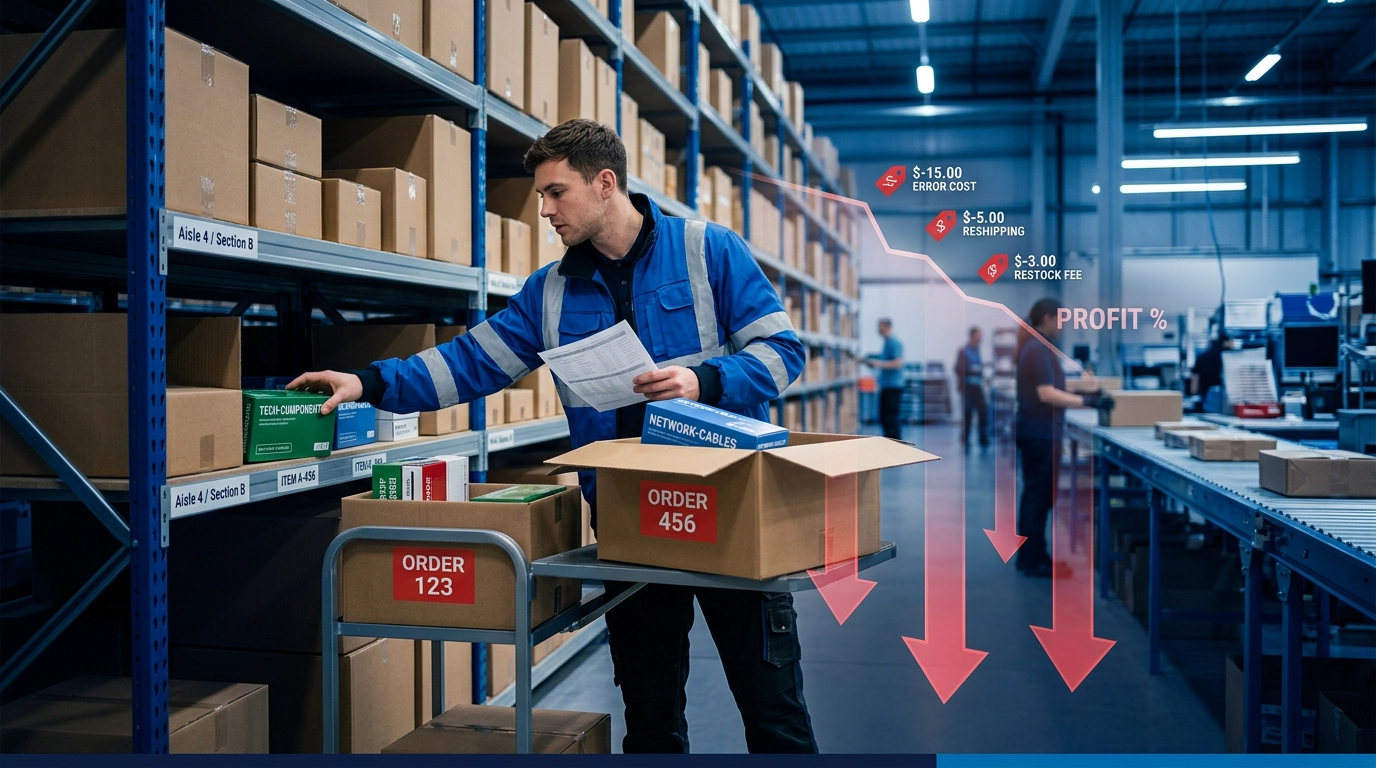
Picking errors are one of the most underestimated threats in e-commerce logistics. While many companies focus on attracting new customers and accelerating deliveries, they often overlook a costly reality happening inside the warehouse. Every wrong item, missing product, or incorrect order shipped directly erodes profitability.
In highly competitive e-commerce environments, customers expect perfect fulfillment. A single mistake can trigger returns, customer service incidents, replacement shipments, and reputational damage. When picking processes are performed manually, these errors become increasingly difficult to control as order volumes grow.
Every picking error generates hidden costs that extend far beyond the value of the wrong product shipped.
Why manual picking generates costly mistakes
Manual picking relies heavily on human attention. Operators must identify locations, verify products, confirm quantities, and prepare orders under constant time pressure. As SKU catalogs expand and order volumes increase, the probability of mistakes grows significantly.
Human errors are inevitable
Even highly trained warehouse employees are vulnerable to:
- Selecting the wrong product reference
- Picking incorrect quantities
- Forgetting items within an order
- Confusing similar-looking products
- Picking from incorrect locations
These mistakes become more frequent during seasonal peaks, promotions, or high-demand periods.
Complexity increases operational risk
Modern e-commerce operations often manage:
- Thousands of SKU references
- Multiple product variants
- Continuous inventory movements
- Same-day shipping commitments
Without real-time validation systems, warehouse teams depend entirely on visual checks and manual verification processes.
The result is simple: increased operational risk and reduced order accuracy.
The true cost of a picking error
Many organizations only calculate the direct cost associated with correcting an order. However, the financial impact is much larger.
Direct operational costs
When an incorrect order is shipped, companies typically incur:
- Reverse logistics costs
- Product return handling
- Replacement shipment expenses
- Customer service intervention time
- Additional warehouse labor
Each error generates multiple operational activities that consume resources.
Indirect costs that hurt profitability
The most dangerous consequences are often invisible.
These include:
- Customer dissatisfaction
- Negative reviews
- Lower repurchase rates
- Reduced brand trust
- Increased customer acquisition costs
In e-commerce, customer experience is a competitive advantage. A fulfillment mistake can quickly become a lost customer.
Comparing manual versus automated validation
| Operational challenge | Manual picking | RFID-enabled validation |
|---|---|---|
| Product verification | Visual inspection | Automatic identification |
| Order accuracy | Dependent on operator attention | Real-time validation |
| Error detection | After shipment | Before shipment |
| Scalability | Limited by workforce | Easily scalable |
| Customer satisfaction | Variable | Consistently high |
How picking errors impact customer experience
The customer only sees one thing: whether the order was correct. They do not distinguish between warehouse issues, inventory discrepancies, or operational complexities.
Wrong orders create immediate frustration
Receiving the wrong item causes:
- Disappointment
- Additional effort to process returns
- Delays in product availability
- Reduced trust in the retailer
A single negative experience may be enough to encourage customers to explore alternative brands.
Fast delivery means nothing if accuracy is missing
Many e-commerce businesses invest heavily in delivery speed. However, delivering the wrong product quickly does not improve customer satisfaction. Accuracy must come before speed.
Customers remember receiving the correct product more than they remember receiving it a few hours earlier.
How RFID transforms e-commerce order fulfillment
Reducing picking errors requires more than additional training or supervision. Businesses need automated verification mechanisms capable of identifying mistakes before orders leave the warehouse.
This is where RFID technology becomes a strategic advantage.
Real-time product identification
RFID allows every tagged item to be identified instantly without manual scanning.
During packing and dispatch operations, products can be automatically verified against the customer order.
This enables warehouses to detect discrepancies before shipment.
Automated order validation
With an RFID-powered e-commerce solution, organizations can:
- Verify order completeness automatically
- Detect incorrect products instantly
- Reduce manual quality controls
- Increase fulfillment accuracy
- Accelerate shipping processes
The result is a more reliable operation with fewer costly incidents.
Data-driven continuous improvement
Accurate visibility is essential for operational excellence. Through Zentup, companies can transform fulfillment data into actionable insights, identifying:
- Error patterns
- Operational bottlenecks
- Productivity trends
- Inventory discrepancies
Data intelligence helps logistics leaders move from reactive problem-solving to proactive optimization. Learn more about how data visibility improves warehouse performance through Zentup and connected logistics solutions available at Clustag.
Building a scalable and error-free e-commerce operation
As order volumes grow, manual controls become increasingly difficult to maintain.
Organizations that continue relying on manual picking often face:
- Higher operational costs
- Increased return rates
- Lower customer satisfaction
- Reduced profitability margins
Operational excellence requires automation
To create a scalable fulfillment process, businesses need technologies capable of:
- Automatically validating products
- Providing real-time inventory visibility
- Eliminating repetitive manual checks
- Supporting business growth without proportional labor increases
RFID-enabled e-commerce solutions provide exactly this foundation.
The competitive advantage of error-free fulfillment
Companies that consistently deliver accurate orders benefit from:
- Better customer retention
- Lower logistics costs
- Higher operational efficiency
- Stronger brand reputation
- Improved profitability
In today’s e-commerce landscape, fulfillment accuracy is no longer a warehouse metric. It is a business growth driver.
Frequently asked questions
How much can picking errors impact profitability?
Picking errors generate direct costs such as returns, replacement shipments, and customer service interventions. They also create indirect costs through customer dissatisfaction and lost future sales.
Why do manual picking processes generate mistakes?
Manual operations depend on human attention and verification. As SKU volumes and order complexity increase, the probability of errors rises.
What is the biggest hidden cost of picking errors?
The largest hidden cost is often customer churn. A poor fulfillment experience can damage trust and reduce repeat purchases.
How does RFID reduce picking errors?
RFID automatically identifies products and validates orders in real time, allowing warehouses to detect mistakes before shipment.
Can RFID improve warehouse productivity?
Yes. RFID reduces manual verification tasks, speeds up fulfillment processes, and enhances operational efficiency.
What role does Zentup play in fulfillment optimization?
Zentup provides operational intelligence by transforming logistics data into insights that help companies improve accuracy and performance.
Is RFID only useful for large e-commerce operations?
No. Businesses of all sizes can benefit from improved order accuracy, reduced returns, and greater warehouse visibility.
How can companies test RFID solutions before implementation?
Organizations can visit the Clustag Customer Experience Center to evaluate RFID use cases using their own products and operational scenarios.
Ready to eliminate costly picking errors?
Picking mistakes may seem like isolated incidents, but they create a continuous drain on profitability, customer satisfaction, and operational efficiency.
If you want to discover how RFID-powered e-commerce solutions can help you achieve near-perfect order accuracy, contact our team or visit our Customer Experience Center to test the technology with your own products and processes.