
An RFID tunnel is one of the most effective ways to bridge the gap between manual warehouse operations and advanced automation. For many operations leaders, the challenge is not whether to automate, but when and how to do it without disrupting performance or overinvesting too early.
In environments where manual handling still dominates, introducing controlled and scalable automation becomes a strategic decision. The goal is to improve data capture, traceability, and throughput while maintaining operational flexibility.
The real question is not about adopting automation, but about identifying the indicators that justify it.
Why manual environments reach their limits
Before implementing any solution, we need to understand the operational pain points that reveal the need for change. Manual processes can work effectively up to a certain scale, but they eventually show structural limitations.
Data inconsistencies and lack of real-time visibility
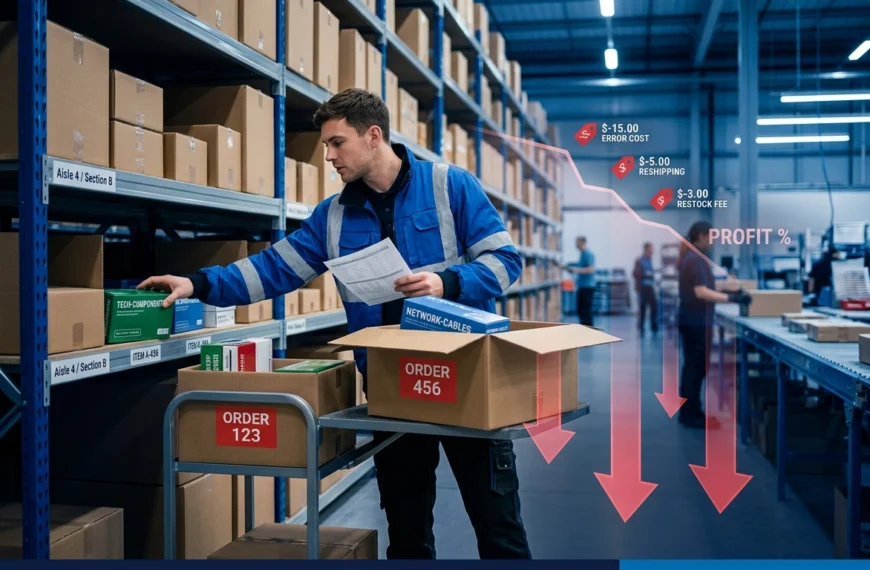
In manual workflows, data capture depends heavily on operators. Barcode scans, visual checks, or manual inputs introduce variability and errors.
Typical signals include
- Mismatches between physical stock and system records
- Delayed updates in inventory systems
- Limited traceability across movements
This lack of reliable data affects decision-making at every level, from daily operations to strategic planning.
Increasing pressure on throughput and labor
As volumes grow, manual processes become harder to sustain. Scaling operations often means scaling workforce, which is not always efficient.
Key indicators include
- Rising labor costs per processed unit
- Difficulty maintaining peak productivity
- Bottlenecks at critical control points
At this stage, improving efficiency requires more than optimization—it requires introducing automation in a controlled way.
RFID tunnel as a scalable entry point into automation
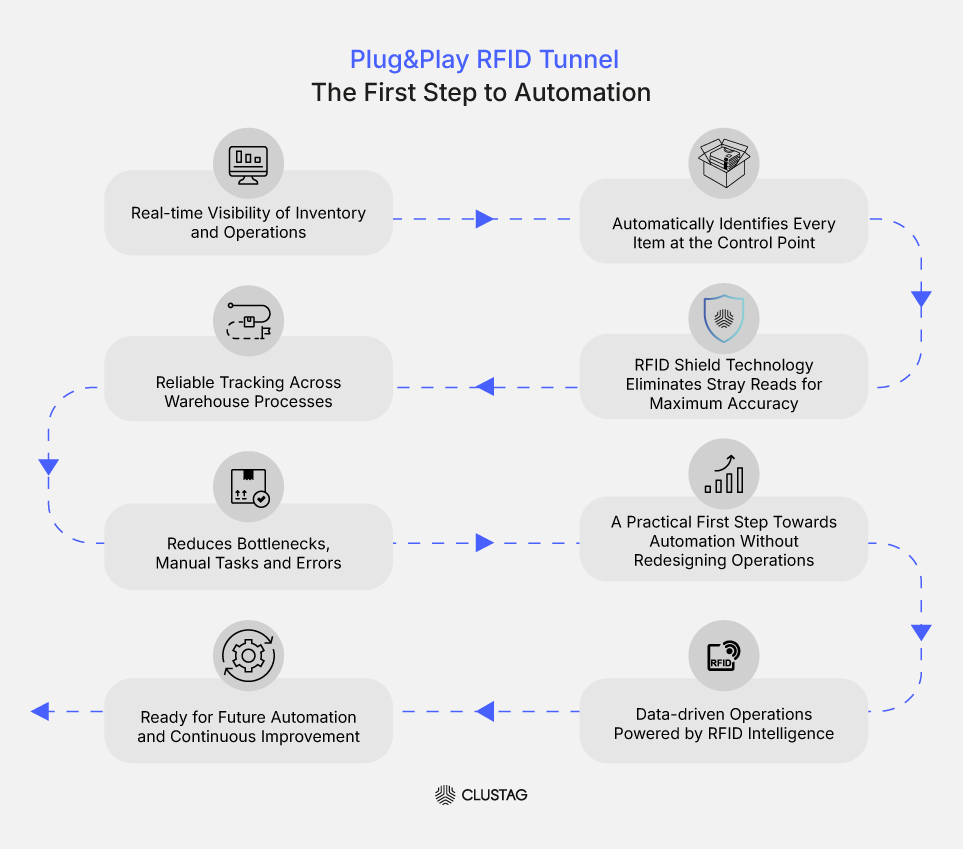
An RFID tunnel provides a structured and progressive approach to automation. Instead of redesigning the entire warehouse, we introduce automation at key checkpoints where it generates the highest impact.
Controlled automation without process disruption
One of the main advantages of semi-automated systems is that they adapt to existing workflows rather than replacing them.
This allows us to
- Maintain current operational logic
- Introduce automation incrementally
- Minimize resistance to change within teams
The result is a smoother transition from manual to data-driven operations.
Consistent and automated data capture
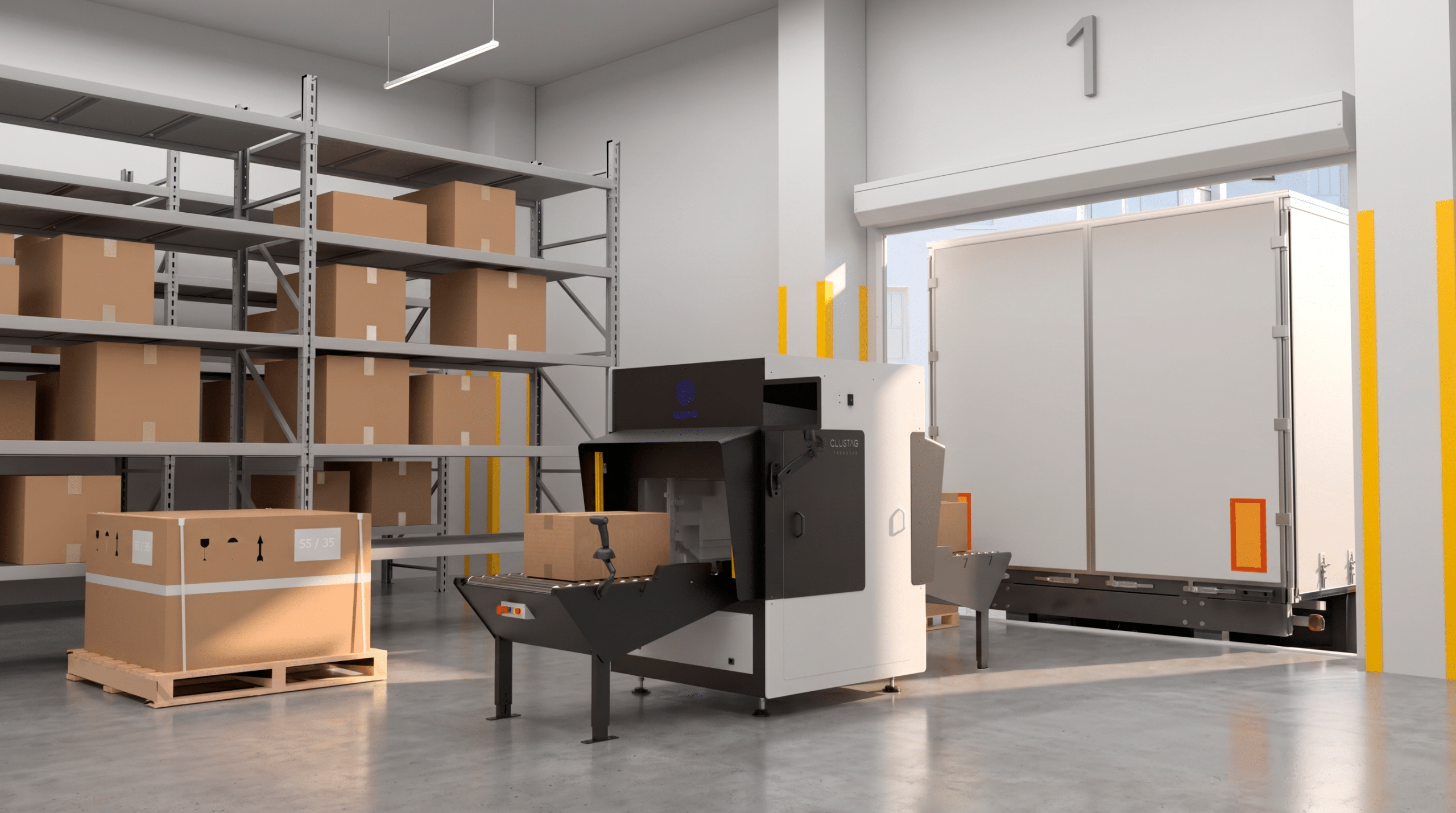
An RFID tunnel ensures that every item passing through a control point is automatically identified and recorded.
With solutions like Clustag RFID Systems, we can
- Eliminate manual scanning errors
- Capture data in real time
- Standardize information flows across operations
This consistency is essential for building reliable analytics and improving overall performance.
The importance of encapsulation in RFID tunnel performance
Not all RFID implementations deliver the same results. One critical factor that often determines success or failure is how well the reading environment is controlled.
Eliminating stray reads and improving accuracy
Warehouses are complex RF environments, where signals can interfere and produce inaccurate readings.
A proper encapsulation strategy allows us to
- Isolate the reading zone
- Prevent unwanted tag detection
- Improve read precision
This is where RFID Shield Technology becomes essential, ensuring that the tunnel reads exactly what it should, and nothing more.
Building trust in operational data
When data is inconsistent, teams stop relying on it. A well-encapsulated RFID tunnel guarantees stable performance and builds confidence across the organization.
This leads to
- Better operational decisions
- Higher adoption of technology
- Stronger alignment between systems and reality
Turning RFID tunnel data into operational intelligence
The value of an RFID tunnel goes beyond identification. It becomes a powerful source of data that can transform how warehouses operate.
From raw reads to meaningful insights
Capturing data is only the first step. Processing and structuring it is what creates value.
With Zentup data intelligence, we can
- Convert raw reads into actionable events
- Visualize flows in real time
- Detect inefficiencies and process deviations
Enabling future automation strategies
Reliable data is the foundation for more advanced initiatives. Once an RFID tunnel is in place, it becomes easier to evolve toward higher levels of automation.
This includes
- Predictive process optimization
- Integration with automated systems
- Continuous improvement based on real data
Comparing manual processes and RFID tunnel implementation
To support decision-making, it is essential to compare current operations with a semi-automated approach.
| Operational factor | Manual environment | RFID tunnel approach |
|---|---|---|
| Data accuracy | Operator-dependent | Automated and consistent |
| Traceability | Partial and delayed | Real-time visibility |
| Throughput | Limited by labor | Increased without major changes |
| Scalability | Complex and costly | Progressive and controlled |
| Reliability | Variable | Stable and predictable |
This comparison helps operations directors quantify the impact and justify the transition based on measurable improvements.
When an RFID tunnel becomes the right decision
Not every warehouse needs full automation, but many reach a point where manual processes are no longer enough.
The right moment typically arrives when
- Data errors start impacting business outcomes
- Labor costs scale faster than productivity
- Traceability becomes a critical requirement
At this stage, an RFID tunnel is not just an improvement—it is a strategic step forward.
From operational challenge to practical solution
Once these indicators are clear, the next step is choosing a solution that combines performance, ease of implementation, and scalability.
Solutions like the MOT Lite A34 represent this approach, offering
- Plug-and-play deployment to reduce implementation time
- Controlled RFID environments with proper encapsulation
- Reliable data capture ready to be integrated into existing systems
If you want to explore how this type of solution can fit your operation, we invite you to discover the MOT Lite solution and evaluate its potential in your environment.
The most effective path to automation starts with control, visibility, and the ability to scale at your own pace.
We also recommend visiting our Customer Experience Center to test these solutions with your own products or contacting our team to assess your specific use case.