

Preparing your warehouse for Black Friday is not simply about handling more orders. It is about making sure that every part of the operation can absorb higher volumes without transferring bottlenecks from one process to the next.
With the Black Friday and Christmas peak approaching, the question is simple: is your warehouse really ready?
Sortation capacity matters, but so do picking buffers, staffing, maintenance, outbound validation, data visibility and contingency planning. A warehouse can have fast equipment and still lose performance when one critical process cannot keep pace with the rest.
Peak readiness is not about maximizing the speed of one machine. It is about protecting the flow of the entire operation.
Our practical checklist focuses on the areas logistics teams should review before seasonal demand puts the operation under pressure.
How to prepare your warehouse for Black Friday
The best moment to identify a capacity problem is before peak volumes arrive. We should approach preparation as an end-to-end exercise, following the physical and digital journey of an order through the distribution center.
The objective is not simply to calculate theoretical throughput. We need to understand what happens when receiving, picking, sortation, validation and shipping are operating simultaneously under pressure.
Preparing your warehouse for Black Friday starts with the real flow
Start by mapping the order journey from inventory availability to dispatch.
Review:
- Inbound capacity
- Storage and replenishment
- Picking capacity
- Buffer and accumulation areas
- Conveyor capacity
- Sorter induction and destination capacity
- Packing and order verification
- Outbound staging
- Loading dock capacity
- WMS, WES, ERP and operational data integration
This exercise can expose an important problem. Increasing capacity at one point does not necessarily increase warehouse capacity as a whole.
If picking produces orders faster than downstream processes can absorb them, accumulation grows. If sortation accelerates but packing cannot follow, the bottleneck simply moves downstream.
Establish your peak throughput target
We should define the expected peak workload for each critical process rather than relying only on average daily volumes.
For every area, document:
- Expected units or orders per hour
- Sustained processing capacity
- Short-term peak capacity
- Maximum acceptable queue
- Available buffer
- Recovery procedure after a stop
- Upstream and downstream dependencies
This creates a much more useful picture than looking at equipment specifications independently.
Check sorter capacity before demand peaks
Sorters are one of the most visible elements of an automated warehouse, but nominal sorter speed tells only part of the story. Actual performance depends on induction, product characteristics, destination availability, control systems and the processes immediately upstream and downstream.
Our internal automation materials describe sorters as systems suited to large and relatively stable volumes, with considerably high throughput but less flexibility than other preparation technologies.
Test the complete sorter process
We should test more than the central sorter.
Include:
- Induction
- Separation
- Identification
- Tracking
- Diverts
- Destination availability
- Recirculation or rejection flows
- Downstream evacuation
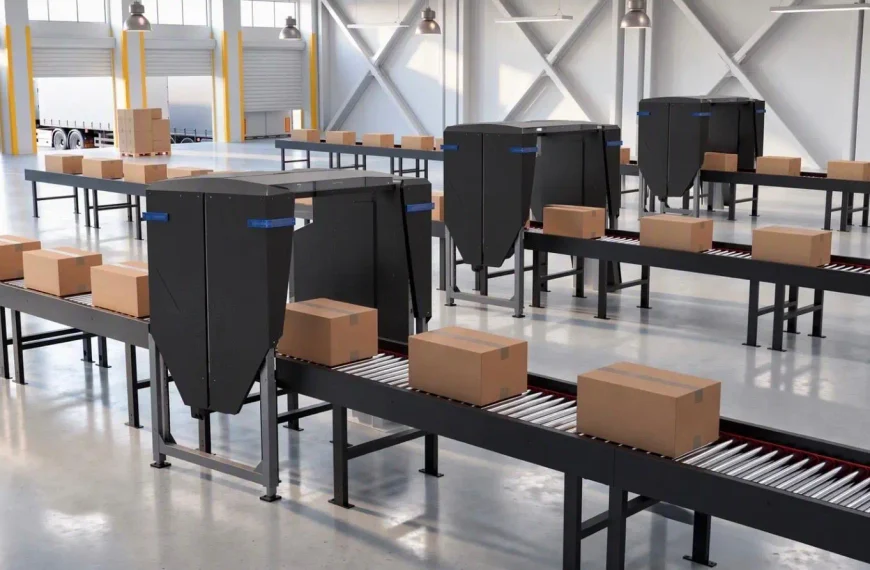
For example, Clustag’s Lite Sorter tracks product positions along the conveyor and activates a pneumatic divert when the encoder position corresponds with the designated destination. This illustrates why mechanical flow, tracking and control logic need to perform as one system.
Identify what happens when a destination fills up
This is where theoretical capacity and operational capacity can diverge.
Ask practical questions:
- What happens when one destination accumulates faster than operators can clear it?
- Can blocked destinations affect upstream flow?
- How fast can the team recover after a stoppage?
- Where will rejected products go during peak operation?
- Which component limits sustained throughput?
The objective is to find the weakest link before Black Friday traffic finds it for us.
Protect the picking buffer
Picking should never be viewed as an isolated productivity metric. A high picking rate only adds value if downstream processes can continuously absorb what is being prepared.
During Black Friday and Christmas logistics operations in Spain, buffer management therefore becomes essential to maintaining stable flow.
Size the buffer around downstream capacity
We need to understand the relationship between picking output and the next process.
A practical buffer review should include:
- Available physical positions
- Average order or tote dwell time
- Picking output
- Packing consumption rate
- Sorter induction rate
- Rejection and rework volume
- Rules for prioritizing urgent orders
The goal is not to fill every available position. A buffer should absorb variability without becoming permanent storage.
Keep visibility over pending and unexpected items
This is where identification and operational data become especially valuable.
Clustag RFID-enabled workstations can provide item-level validation during order preparation, while Zentup Workflow can display expected, pending, unexpected and excess items and integrate information with business systems such as ERP, SAP or WMS.
That data layer helps us detect deviations closer to the point where they occur instead of allowing errors to travel further through the operation.
Review shifts and people before adding capacity
Peak demand is also a people challenge. Additional equipment capacity means little when critical workstations, replenishment tasks, exception processes or maintenance functions do not have adequate coverage.
The workforce plan should therefore be designed around the operation rather than simply increasing headcount everywhere.
Cover critical roles across every shift
Create a coverage matrix for:
- Picking
- Replenishment
- Packing
- Induction
- Sorter destinations
- Exception handling
- Shipping
- Maintenance
- Controls and software support
- Shift supervision
Also identify which functions need cross-trained backup.
A simple question can reveal significant risk:
If one specialist is unavailable during the busiest shift, which process stops or slows down?
Train for exceptions, not only the standard flow
During quieter periods, operators become familiar with normal operation. Peak periods expose them to the exceptions.
Training should therefore cover situations such as:
- Rejected items
- Incorrect order contents
- Blocked destinations
- Equipment stops
- Re-induction
- Manual fallback procedures
- Escalation paths
Every minute spent deciding what to do during an exception becomes expensive when thousands of orders are waiting upstream.
Complete preventive maintenance before Black Friday
The weeks immediately preceding the campaign are the time to remove avoidable technical risks.
Preventive maintenance should cover mechanical components, sensors, controls, safety elements and critical software connections. Clustag’s lifecycle approach includes maintenance and support as part of the solution lifecycle, and its support material specifically covers specialized software and PLC support.
Inspect the components that can stop the flow
Build the maintenance review around criticality rather than convenience.
Check, where applicable:
- Conveyor components
- Drives and motors
- Belts and rollers
- Pneumatics
- Diverts
- Sensors and encoders
- Safety systems
- RFID reading points
- PLC communication
- Network connections
- WMS, WES and ERP interfaces
Do not wait for peak week to discover a component that was already showing signs of degradation.
Define critical spare parts and escalation
For every critical asset, we should know:
- Which failure modes can stop production?
- Which spare parts are available on-site?
- Who is authorized to intervene?
- Who owns the escalation?
- What alternative flow is available while the incident is resolved?
This turns maintenance from a technical activity into a business-continuity measure.
Give peak operations real-time visibility
Peak capacity becomes much easier to manage when operations teams can see what equipment is doing and identify abnormal behavior quickly.
That requires connecting the physical flow with the information flow.
Use Zentup to connect RFID and operational data
Zentup is Clustag’s software integration platform between RFID devices and business management systems. Its documented functionality includes monitoring the operational status of RFID reading points, reader configuration and firmware updates, system management, user management and open APIs for integration with enterprise systems.
During peak demand, this creates an important foundation for operational visibility because exceptions can be identified from data rather than discovered only after they affect downstream processes.
Prevent stray reads from creating false exceptions
RFID accuracy also depends on controlling the reading environment.
Clustag RFID Shield Technology creates an interference-resistant environment designed to mitigate external RFID signal interference and stray reads.
That becomes relevant in dense logistics environments where multiple RFID-enabled products or reading points may operate close together.
| Peak risk | Operational response |
|---|---|
| Picking outruns packing | Control release rates and maintain buffer visibility |
| Sorter destination saturates | Review destination capacity and exception flow |
| Incorrect order continues downstream | Validate contents closer to picking or packing |
| RFID stray reads generate incorrect data | Use controlled reading environments with RFID Shield Technology |
| Teams cannot see device status | Centralize RFID device visibility with Zentup |
| Equipment fails during peak | Complete preventive maintenance and prepare critical spares |
| Outbound error reaches the truck | Add final shipment validation where appropriate |
Verify orders before they leave the warehouse
Black Friday puts pressure on throughput, but speed cannot come at the cost of shipping accuracy.
The later an error is detected, the more operational effort can be required to recover it. Adding validation at the right checkpoints can therefore protect both throughput and outbound quality.
Validate at packing and post-picking
Clustag solutions can integrate RFID validation into packing and post-picking processes.
Internal e-commerce documentation describes RFID-enabled workbenches for faster item identification and order preparation, as well as automated validation solutions within conveyor-based flows.
This creates a checkpoint before an incomplete or incorrect order moves further downstream.
Protect the final outbound checkpoint
The loading dock is another strategic validation point.
Clustag’s RFID Portal validates pallet composition and dispatch directly at the dock and is designed to integrate with existing outbound processes.
For operations already using RFID at item, carton or pallet level, this provides another way to detect discrepancies before goods physically leave the distribution center.
The Black Friday warehouse readiness checklist
Before peak demand arrives, we recommend running one final cross-functional review.
Capacity
- Peak volume forecast reviewed
- Picking capacity validated
- Sorter capacity validated under realistic conditions
- Packing capacity checked
- Outbound capacity reviewed
- Buffer limits documented
People
- Shift coverage defined
- Critical roles have backup
- Operators trained in exception handling
- Escalation responsibilities assigned
Technology
- WMS/WES/ERP integrations checked
- PLC and control communications reviewed
- RFID reading points validated where applicable
- Operational visibility available to the right teams
- Stray-read risks controlled in RFID zones
Maintenance
- Preventive maintenance completed
- Critical spare parts available
- Sensors and actuators checked
- Safety systems validated
- Technical escalation path established
Contingency
- Manual fallback flows documented
- Rejection and rework areas prepared
- Recovery procedure after stoppages tested
- Priority orders can be identified and processed
The best Black Friday incident is the one we discover during a test, not during the peak.
Build a warehouse that is ready for more than one peak
Black Friday and Christmas put warehouse design, automation and operational processes under unusual pressure. But preparing correctly for the campaign can also reveal where the operation needs to become more resilient for the rest of the year.
At Clustag, we design and deliver end-to-end solutions across RFID intralogistics and intralogistics automation, including conveyors and sorters, with integrations designed to connect physical product flows with operational data.
Rather than optimizing an isolated machine, we can evaluate the complete operational flow, from picking and identification to sortation, validation and shipping.
If you are preparing your warehouse for Black Friday or planning the next stage of your automation strategy, fill in our contact form or visit our Customer Experience Center to test solutions using your own products and operational scenarios.
The Clustag showroom includes solutions that can be tested with conveyors under real operating conditions.
Frequently asked questions
How early should we prepare a warehouse for Black Friday?
Preparation should begin early enough to identify bottlenecks, complete preventive maintenance, validate staffing and run representative tests before peak volumes arrive. The objective is to leave time to correct problems, not simply identify them.
What should we test before Black Friday?
We should test the complete order flow, including picking, buffers, induction, sortation, packing, exceptions, validation and outbound processes. Testing individual machines alone can hide dependencies between areas.
How can we tell if our sorter has enough capacity?
Compare expected peak flow with sustained end-to-end throughput, including induction and destination evacuation. The real constraint may be upstream or downstream rather than the sorter itself.
Why are picking buffers important during peak periods?
Buffers absorb short-term differences between picking output and downstream consumption. Without adequate control, however, a buffer can become another bottleneck and obscure problems elsewhere in the flow.
When does RFID add value during Black Friday?
RFID can support item-level identification, order validation, inventory visibility and outbound verification where the operation and tagging model are appropriate. Clustag documentation covers RFID implementations across inbound, picking and shipping processes.
What is RFID Shield Technology?
RFID Shield Technology is Clustag’s stray-read mitigation approach. It creates an interference-resistant reading environment intended to reduce external RFID interference and improve reading stability.
What role does Zentup play during peak operations?
Zentup connects RFID devices with business management systems and provides capabilities including device monitoring, configuration, system management, user management and APIs for enterprise integration.
Can we test Clustag solutions before implementing them?
Yes. Internal product material states that the Clustag showroom allows customers to test and validate solutions under real conditions, including conveyor-based scenarios.