
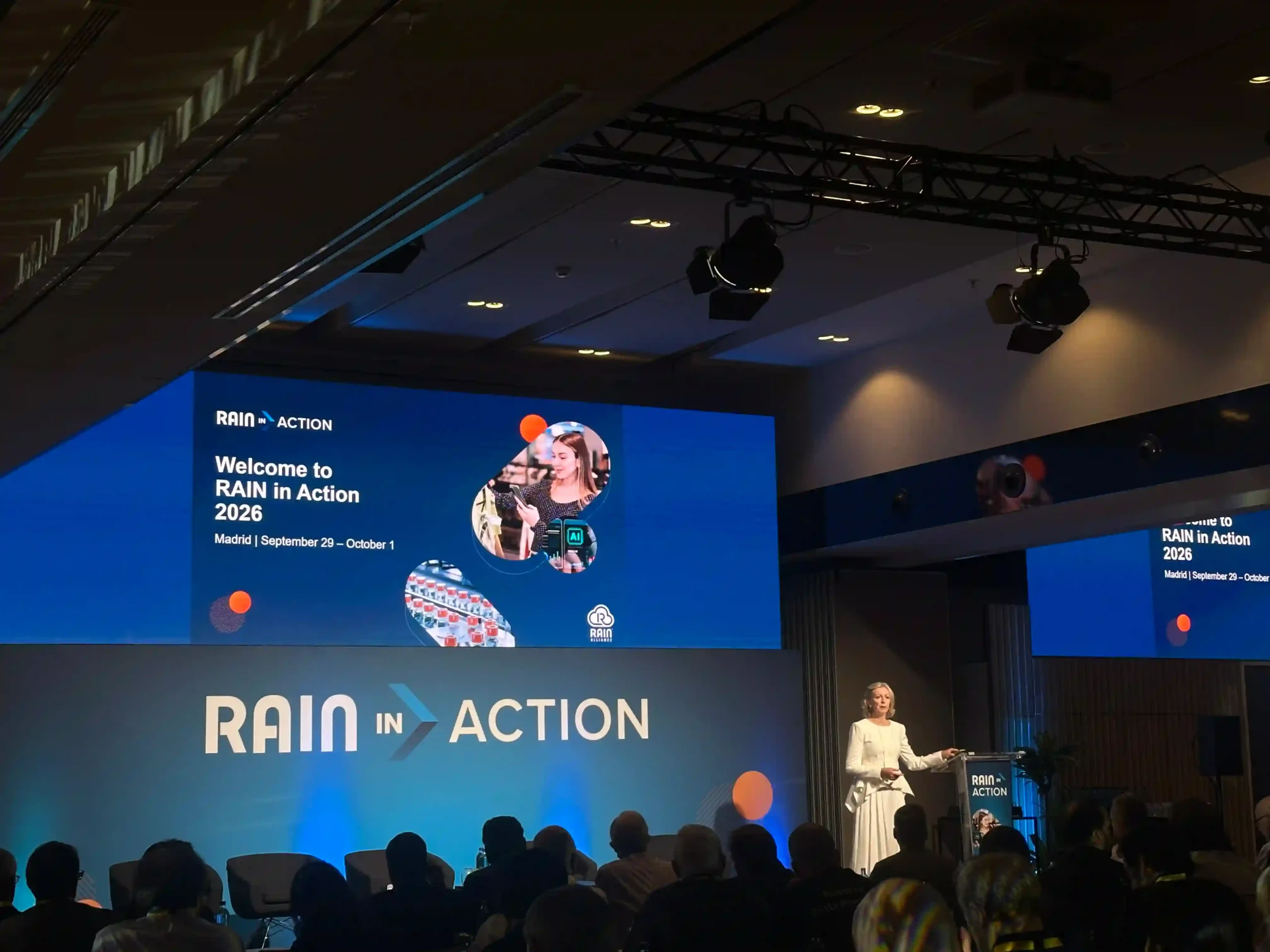
RAIN in Action 2026 confirmed that the conversation around RFID has moved far beyond inventory visibility. Throughout the event, leading organizations including VF Corporation, UPS, Inditex, Amazon, IKEA and JD Sports shared how they are using RAIN RFID to improve operations, automate decisions and create more connected retail and logistics ecosystems.
Although each company presented a different use case, a common theme emerged across every session. RFID is evolving from a technology focused on identification into an infrastructure capable of supporting automation, operational intelligence and real-time decision-making.
From our perspective at Clustag, this evolution is particularly relevant because it highlights a challenge we encounter daily across both retail environments and intralogistics operations: the value of RFID does not depend solely on reading tags. It depends on ensuring that every reading generates reliable, contextualized and actionable data.
The future of RFID is not simply identifying products. It is enabling trusted operational decisions based on real-world events.
What RAIN in Action 2026 revealed about the future of RAIN RFID
The companies presenting at RAIN in Action were addressing different operational challenges, but all were moving toward the same goal: making physical processes more visible and digitally actionable.
End-to-end inventory visibility based on reliable data
VF Corporation demonstrated how RFID can connect inventory information across multiple stages of the supply chain.
The company highlighted the importance of maintaining a consistent product identity from origin to distribution centers and stores. Achieving visibility across the entire network requires more than deploying additional readers. It requires consistency in the way information is captured and interpreted throughout the supply chain.
From our experience, this becomes particularly relevant in intralogistics environments where receiving processes, shipment validation and inventory control depend on reliable RFID data capture.
From scanning events to automated decisions
UPS presented its transition from a traditional scanning network toward a sensing and responding network.
This approach reflects an important shift. The objective is no longer simply recording that an asset has passed through a location. Instead, RFID events become triggers for operational actions and automated decisions.
As automation increases, controlling the reading environment becomes critical. Reading accuracy alone is not enough. Organizations must also ensure that only the tags associated with a specific operational process are captured and validated.
RFID becoming part of store operations
Inditex offered one of the clearest examples of RFID maturity within retail.
The company showed how a single product identity can support inventory management, replenishment, product location, customer service and loss prevention throughout the store.
This demonstrates that RFID is no longer an isolated project. Instead, it becomes embedded within day-to-day retail operations.
How RAIN RFID is transforming both in-store and intralogistics operations
One of the most valuable lessons from RAIN in Action is that RFID is creating opportunities across both customer-facing retail processes and logistics operations.
In-store RFID is driving operational efficiency and customer experience
Amazon demonstrated how RFID can contribute directly to frictionless shopping experiences.
The combination of RFID and artificial intelligence shows that different technologies can complement one another depending on the challenge being addressed. RFID provides unique product identity, while computer vision can contribute additional contextual information.
For in-store environments, precision becomes essential because inaccuracies impact not only internal processes but also customer trust.
Intralogistics RFID requires different reading strategies
IKEA shared an approach focused on pallet-level identification rather than item-level tracking.
This is a significant reminder that RFID projects should always start with the operational objective. Different assets require different identification strategies.
Pallet validation, warehouse inventory automation and location tracking present challenges related to tag density, materials, orientation and movement. These conditions are very different from those found in retail stores.
One technology, multiple operational contexts
A recurring message throughout the event was that RFID deployments cannot follow a one-size-fits-all model.
A warehouse portal, a store entrance, a checkout area, a validation station and a fitting room all present distinct physical conditions.
Organizations that successfully scale RFID understand that each environment requires a tailored reading strategy aligned with a specific operational objective.
What retailers are learning about inventory confidence
JD Sports introduced a concept that appeared repeatedly throughout several sessions: moving from inventory accuracy to inventory confidence.
Accuracy alone is no longer enough
Having an accurate inventory snapshot is valuable, but businesses increasingly need something more important.
They must be confident enough in the data to:
- Promise product availability to customers
- Trigger replenishment processes
- Validate shipments
- Automate inventory decisions
- Support omnichannel operations
When businesses trust the information they receive, RFID evolves from a visibility tool into a business infrastructure.
Product identity continues creating value beyond inventory
JD Sports also highlighted how product identity can support additional initiatives related to authentication, resale and sustainability.
This demonstrates how a single RFID-enabled identity can continue generating value throughout the product lifecycle.
Common lessons from VF Corporation, UPS, Inditex, Amazon, IKEA and JD Sports
Despite their different priorities, the companies at RAIN in Action shared several common themes.
| Company | Main challenge | Key learning |
|---|---|---|
| VF Corporation | End-to-end visibility | Reliable product identity across the supply chain |
| UPS | Operational automation | RFID events must trigger trusted decisions |
| Inditex | Store operations | RFID becomes part of everyday retail processes |
| Amazon | Frictionless shopping | Accuracy is fundamental for customer-facing applications |
| IKEA | Pallet identification | RFID architecture must match operational objectives |
| JD Sports | Inventory confidence | Trusted data enables business automation |
The pattern behind all these initiatives can be summarized as:
Identity → Reliable reading → Context → Decision → Action
This progression illustrates how RFID maturity is evolving across industries.
Why reliable RFID data remains the foundation of automation
As organizations increase the level of automation within retail and logistics operations, the quality of RFID data becomes increasingly important.
Reading RFID is different from automating with RFID
The event clearly showed that successful RFID projects require more than detecting tags.
Organizations must answer key operational questions:
- What products should be identified?
- Where should readings occur?
- Which tags belong to the process?
- How should exceptions be handled?
- What business action should be triggered?
The answer to these questions determines whether RFID generates operational value.
Reliable data enables scalable RFID deployments
One lesson was repeated across multiple presentations: scaling RFID successfully depends on trust in the data being captured.
Whether the objective is retail inventory visibility, automated logistics workflows, checkout experiences or pallet management, the ability to make decisions depends on confidence in the underlying RFID events.
The more automated the decision, the more reliable, controlled and contextualized the RFID reading must be.
Final thoughts from RAIN in Action 2026
The strongest takeaway from RAIN in Action 2026 is that RAIN RFID is rapidly evolving from an identification technology into an automation infrastructure.
VF Corporation focused on visibility. UPS focused on automated responses. Inditex embedded RFID into store operations. Amazon connected RFID to customer experiences. IKEA applied RFID to large-scale logistics environments. JD Sports emphasized confidence in product identity.
Although their objectives differ, they are all moving toward the same destination: making physical operations more visible, more interpretable and more actionable through digital technologies.
At Clustag, our experience across both in-store retail environments and intralogistics operations reinforces this same conclusion. The organizations generating the greatest value from RFID are those that focus not only on reading tags, but on transforming every RFID event into reliable operational intelligence.