
RAIN RFID self-checkout gives retailers that already use item-level RFID an opportunity to extract more value from infrastructure that is already operating across their stores. For mature RFID programs, the strategic question is changing. We no longer need to ask only where RFID can be deployed. We can ask how many more retail processes can benefit from the item-level identity that already exists.
This transition is already visible across the industry. ECR Retail Loss describes RFID as supporting inventory visibility, replenishment, loss prevention and omnichannel operations. Its research also examines how existing RFID users can obtain further benefits from their investments.
Checkout deserves particular attention.
Not because self-checkout is new, but because RAIN RFID changes a fundamental part of the interaction: how products can be identified during the transaction.Traditional self-checkout changes who performs the scanning. RAIN RFID creates the possibility of changing how that identification takes place.
If products already have an item-level digital identity, why should checkout remain entirely dependent on identifying them one by one?
From RFID deployment to RFID value creation
Inventory visibility has been an important application of retail RFID, but it does not have to represent the end of the business case.
ECR Retail Loss identifies applications extending from inventory and replenishment to loss prevention and omnichannel operations. Its RFID Innovation Summit has also explicitly referenced applications including smart fitting rooms and self-checkout.
For retailers with an established item-level RFID program, we therefore see an important shift: from deploying the technology to exploiting the infrastructure strategically.
How RFID maturity changes the business case
The opportunity evolves as the RFID program develops.
| RFID stage | Primary focus | Value opportunity |
|---|---|---|
| Deployment | Establish item-level RFID | Create reliable product visibility |
| Expansion | Extend RFID into additional processes | Connect item identification with operational workflows |
| Optimization | Increase the value obtained from existing infrastructure | Reduce unnecessary individual product interactions |
| Advanced use cases | Connect RFID-enabled processes | Create increasingly integrated store operations |
Self-checkout belongs naturally in the later stages. We are not introducing RFID into the store for the first time. We are extending an established identification capability into another important customer and operational touchpoint.
Moving beyond inventory visibility
RAIN RFID can identify multiple tags without requiring barcode-style line-of-sight scanning. ECR Retail Loss specifically notes that RFID readers can capture multiple tags and that the technology can automate processes including self-checkout.
That makes the underlying question broader than inventory accuracy.
We can evaluate where the same item identity can remove friction across:
- Inventory management
- Replenishment
- Omnichannel processes
- Fitting-room applications
- Checkout
- Loss-prevention processes
The objective is to make each RFID deployment contribute to more of the retail operation, rather than treating every application as a completely separate technology project.
RAIN RFID self-checkout changes product identification
Traditional self-checkout changes who performs the scanning, but the interaction can still require the shopper to identify products individually. RAIN RFID creates a different possibility. Instead of designing the checkout experience entirely around one-at-a-time identification, we can build a process around the RFID identity already attached to merchandise.
From self-scanning to item-level identification
The distinction is small in wording but significant operationally.
RAIN RFID tags contain unique identification information, while RFID readers capture that information using radio waves. Unlike a barcode-based process, RFID does not require line of sight and can identify multiple tags.
In an appropriately designed checkout environment, this changes the interaction:
- Less dependence on individual scanning
- Greater use of an item’s existing digital identity
- A more streamlined identification stage
- Greater continuity between checkout and the RFID ecosystem
- A foundation for connecting checkout data with other store systems
The opportunity is not simply to make scanning faster. It is to reduce how much individual scanning the transaction requires.
What changes for customers and store operations
For customers, the goal remains straightforward: autonomy with less friction. For retailers, however, the strategic opportunity is broader. NWe can use the same RFID foundation to support several objectives:
- Customer autonomy by maintaining a self-service journey
- Operational simplicity by reducing individual interaction with merchandise
- Item-level identification by using RFID identity during checkout
- Infrastructure extension by expanding the value of an existing RFID program
- Process consistency by taking RFID further through the physical store journey
This direction also aligns with Clustag’s internal self-checkout use case, which positions checkout as an extension of existing item-level RFID and describes connecting RFID, POS, payment and store systems as part of its co-innovation approach.
Controlled RFID reading becomes the real challenge
Reading more RFID tags is not, by itself, the objective of an RFID checkout. The objective is far more precise: identify the right items inside the right reading area for the right transaction. That distinction becomes critical in a retail store because merchandise does not exist only inside the checkout interaction.
The problem with uncontrolled reads
RFID-tagged products can potentially be present in multiple contexts around a checkout:
- Merchandise being purchased
- Products outside the intended transaction
- Nearby stock or displays
- Products carried around the checkout environment
So maximum read coverage is not necessarily the same thing as maximum process quality.
The checkout needs a controlled read environment in which the identification event corresponds to the transaction we actually want to execute.
| Checkout challenge | Required RFID response |
|---|---|
| Multiple RFID items in the transaction | Reliable item-level identification |
| Merchandise outside the intended transaction | Controlled reading zone |
| Different store layouts | Adaptable checkout design |
| Existing RFID infrastructure | Integration rather than isolated deployment |
| Different customer journeys | Co-designed checkout workflow |
| Multiple enterprise systems | Coordinated RFID and business-system data |
Why physical design matters
An RFID checkout is therefore both a digital and a physical design problem.
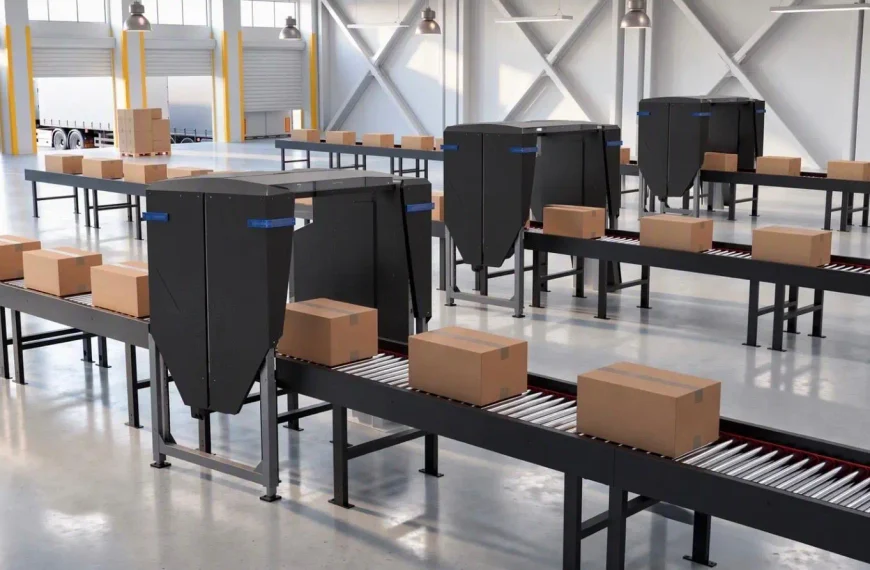
The enclosure, antenna configuration, reader behavior, placement and surrounding store environment influence where RFID identification takes place. The objective is not simply greater RF reach. It is repeatable control of the intended reading area.
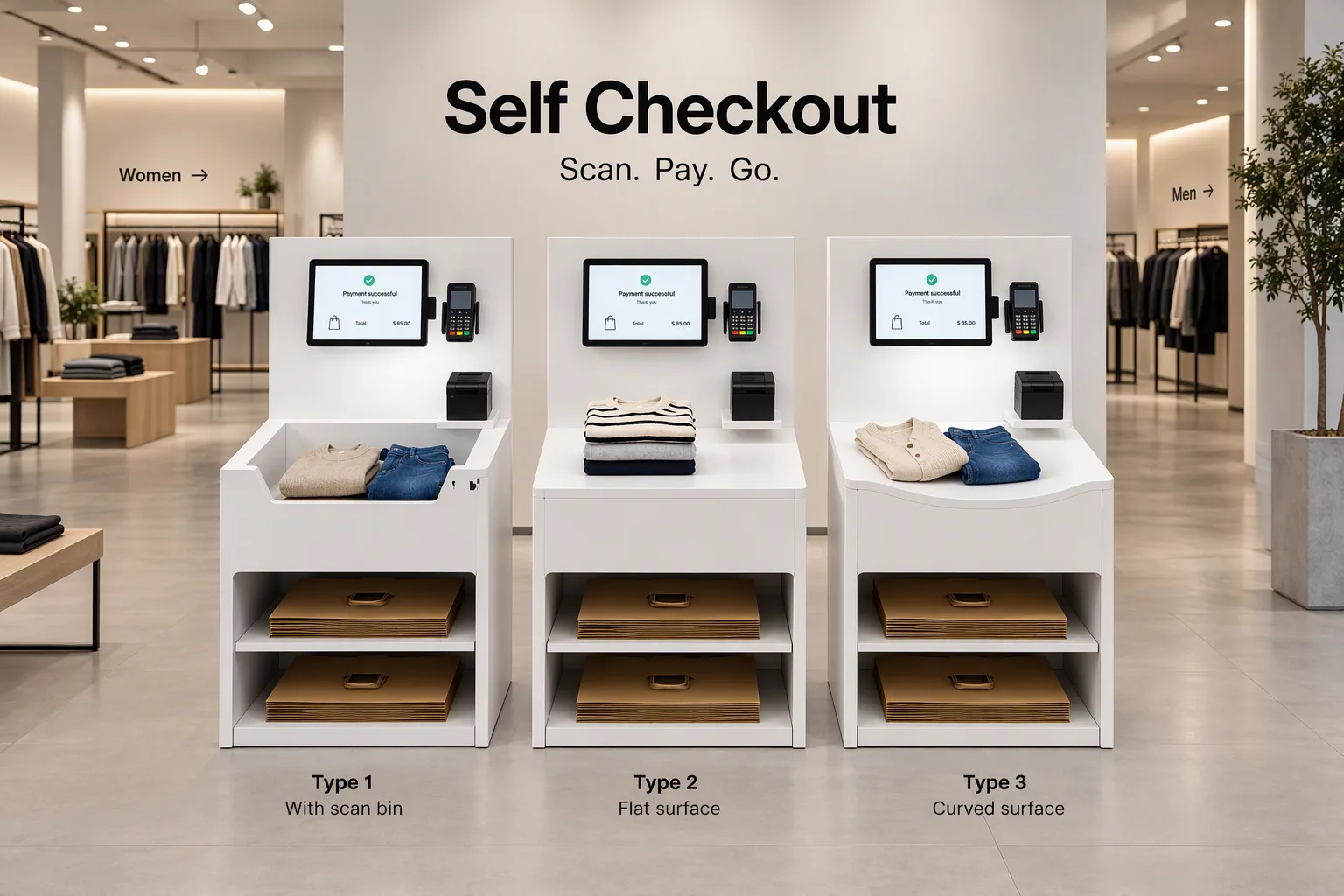
This is also why a standard checkout configuration cannot necessarily meet every retailer’s requirements. RFID Self Checkout identifies differences in layout, customer journey, loss-prevention strategy, RFID ecosystem, store operations and brand experience as reasons to co-design the solution around each retail environment.
How shielding supports reading-zone control
Where an RFID checkout is designed around a confined reading space, RF shielding can become part of the strategy for controlling the identification zone.
For us, this shifts the engineering target from“How many tags can we read?” toward“How accurately can we define which tags should participate in this interaction?”
That is an essential distinction for advanced retail RFID.
Building RFID self-checkout as part of the wider store
A self-checkout station should not become an isolated RFID island.
For retailers that have already invested in RFID, the greater opportunity comes from connecting identification at checkout with the technology and processes already operating elsewhere.
Connecting RFID data with enterprise systems
This is where software becomes important alongside the physical reading environment.
Zentup, Clustag’s RFID middleware, is designed to process and interpret RFID data and connect RFID devices with enterprise management systems. It supports APIs and multiple data protocols, as well as centralized configuration of connected RFID equipment.
For a retailer, this means we can think about the architecture as connected layers:
- RFID-tagged merchandise provides item-level identity
- The controlled reading environment determines where identification occurs
- RFID hardware captures the relevant tags
- Zentup processes RFID data and provides an integration layer with enterprise systems
- Retail systems use the resulting information within the appropriate business workflow
This architecture helps us treat RFID checkout as part of a wider data ecosystem instead of as a standalone reader.
Co-innovation becomes part of the RFID solution
There is no universal RFID self-checkout configuration because there is no universal retail environment. A retailer that has been using RFID for years already has an ecosystem: existing tags, RFID processes, software, store operations, layouts and customer journeys. Self-checkout needs to become part of that ecosystem rather than creating an isolated RFID process.This is where co-innovation becomes especially relevant.
At Clustag, the approach is not to start with a predefined kiosk and adapt the retailer around it. The starting point is the retailer’s existing operation: understanding the customer flow, the RFID environment, the required reading zone, the systems involved and the physical constraints of the store.
Clustag’s internal self-checkout approach reflects this by considering the RFID layer together with the kiosk or furniture, POS, payment platforms and store software, with the solution co-designed around each retail environment.
That means asking questions such as:
- How does the customer naturally interact with the checkout?
- Where should the RFID identification event take place?
- Which tagged products may exist around that area?
- How controlled does the reading zone need to be?
- Which existing systems need to receive or process the RFID data?
- How should the physical design integrate into the store?
- How should the complete concept be validated before scaling?
Co-innovation turns RFID self-checkout from a hardware decision into a retail process design challenge.
For RFID-mature retailers, that distinction is particularly important. The objective is not to deploy RFID again. It is to make an existing RFID ecosystem work in a new, increasingly connected part of the customer journey.
Making existing RFID infrastructure work harder
The next stage of RFID maturity does not necessarily mean deploying RFID in more places simply for the sake of expanding coverage.
It means extracting more operational value from item-level identity.
From individual applications to an RFID ecosystem
For an RFID-mature retailer, we can frame the progression simply:
RFID-tagged merchandise → item-level visibility → connected RFID processes → RFID-enabled checkout
Checkout then becomes another application of the same strategic asset.
And this reframes the investment discussion.
Instead of asking only how many tags, readers or RFID-enabled locations we have deployed, we can evaluate how many valuable operational interactions our item-level data is enabling.
What retailers should evaluate next
Before extending RFID to checkout, we recommend evaluating the complete operating environment rather than only reader performance:
- RFID maturity: Determine what item-level infrastructure is already available
- Customer journey: Identify where individual scanning creates unnecessary interaction
- Read-zone control: Define precisely where merchandise should be identified
- Systems integration: Establish how RFID identification connects with existing retail systems
- Store design: Ensure the physical solution fits the retailer rather than forcing the store around the technology
- Validation: Test the complete customer and RFID interaction under representative store conditions
The strategic question is no longer simply “Should we deploy RFID?” It becomes:
Where else can the item-level identity we already have remove friction from our operations and customer experience?
For RFID-mature retailers, checkout is one of the most relevant places to explore next.