
Handheld RFID vs SABI Station for store-to-store transfers in retail is no longer simply a technology comparison. As retailers handle higher transfer volumes, faster product rotations, and increasingly complex omnichannel operations, many are discovering that handheld readers alone are not always enough to maintain operational control.
At the same time, inventory discrepancies between stores continue to generate stock inaccuracies, reconciliation efforts, and lost sales opportunities. As a result, more retailers are complementing handheld RFID readers with dedicated validation solutions such as SABI Station to achieve greater accuracy during transfer workflows.
Inventory visibility is important. However, when transfer volumes increase, precision becomes the real competitive advantage.
Why store-to-store transfers become a challenge
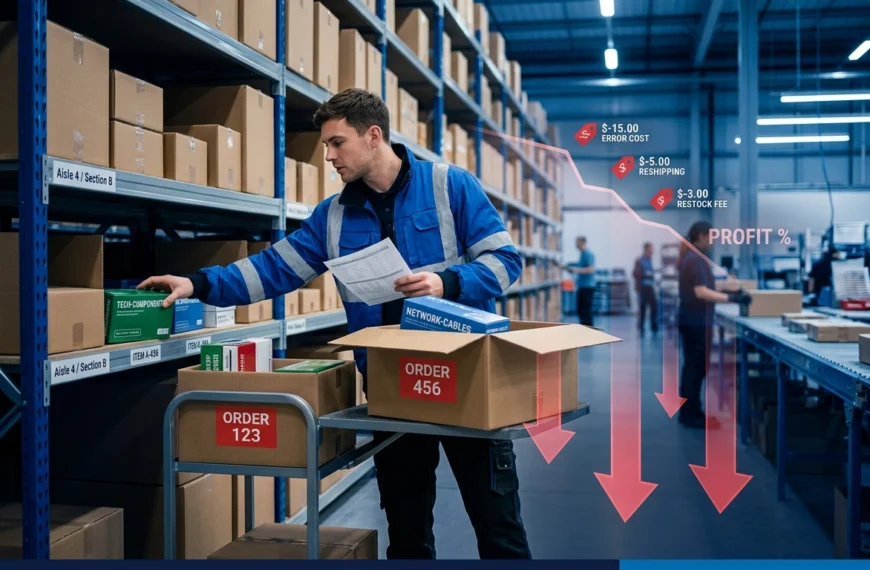
Every transfer involves multiple steps, from preparing products for shipment to receiving them at the destination. Consequently, even a small validation error can create discrepancies between what was sent and what was received.
Furthermore, as omnichannel strategies continue to grow, the volume of store-to-store transfers and store-to-warehouse transfers increases, placing additional pressure on store teams.
The cost of transfer discrepancies
When transfers are not properly controlled, retailers often face:
- Inventory discrepancies between locations.
- Time-consuming investigations and reconciliations.
- Lost sales caused by inaccurate stock information.
- Additional operational costs.
- Reduced confidence in inventory data.
Why manual validation creates risks
Many retailers still rely on manual checks or barcode scans to validate transfer shipments. While these methods may work at low volumes, they become increasingly difficult to manage during seasonal peaks and large stock movements.
| Operational aspect | Manual processes and barcodes | RFID-enabled transfers |
|---|---|---|
| Product verification | Item-by-item scanning | Simultaneous reading of multiple items |
| Validation speed | Operator dependent | Completed in seconds |
| Discrepancy detection | Usually discovered after receiving | Immediate |
| Risk of human error | High | Very low |
| Inventory visibility | Partial | Real-time |
As a result, teams spend less time solving transfer issues and more time focusing on customer-facing activities.
How RFID improves store-to-store transfers
A reliable transfer process requires more than visibility. Retailers need complete traceability, automatic validation, and real-time inventory updates across the entire network.
This is where RFID delivers significant value.
Mass reading and immediate discrepancy detection
Unlike barcode-based workflows, RFID identifies multiple products simultaneously without requiring line-of-sight scanning.
Consequently, retailers can:
- Validate entire transfer boxes in seconds.
- Eliminate manual counting.
- Detect missing or unexpected items immediately.
- Improve operational efficiency.
Real-time inventory visibility
Every validated transfer automatically updates inventory records.
Therefore, retailers gain visibility over:
- Products in transit.
- Products received.
- Current stock levels.
- Inventory movements between stores.
For organizations looking to optimize these workflows, our Store-to-Store Transfer Solution helps automate validation and improve inventory accuracy.
The role of handheld RFID readers
Handheld RFID readers remain one of the most valuable tools available to retail teams. Their mobility allows employees to perform multiple operational tasks using a single device.
What handheld readers do well
Handheld RFID readers are particularly effective for:
- Inventory counts.
- Product searches.
- Goods receiving.
- Quick transfer validations.
Furthermore, they provide flexibility and can support multiple RFID use cases throughout the store.
Where handheld readers reach their limits
However, challenges appear when transfer volumes increase or when products must be validated inside densely packed boxes.
Typical issues include:
- Unwanted reads from nearby products.
- Repeated scans to confirm results.
- Greater dependence on operator actions.
- Reduced efficiency during seasonal peaks.
Therefore, many retailers complement handheld readers with dedicated RFID validation stations.
How SABI Station optimizes transfer validation
To overcome these limitations, Clustag combines handheld RFID readers with controlled reading environments powered by RFID Shield Technology.
SABI Station creates an isolated reading zone that minimizes interference and ensures highly accurate box validation.
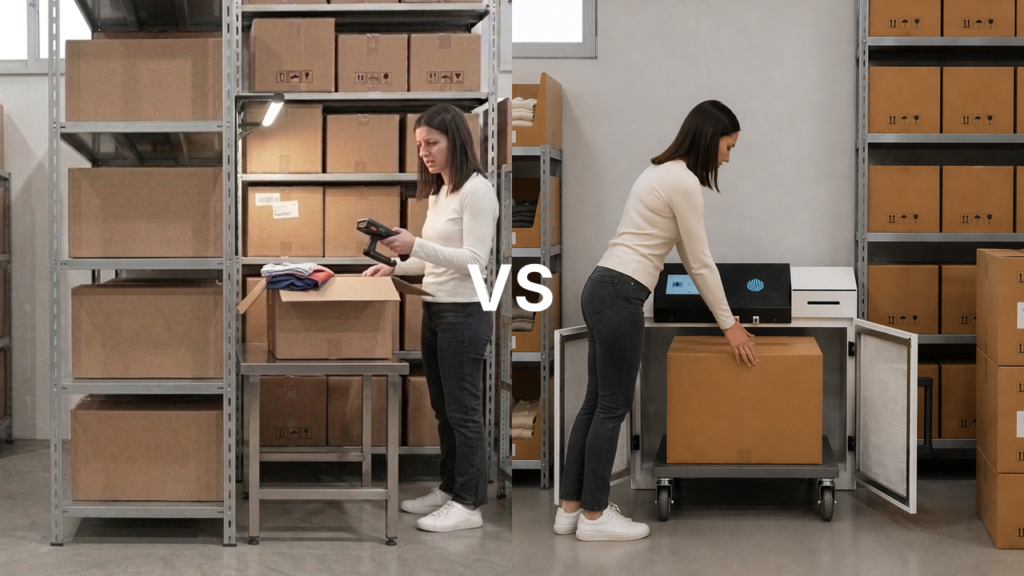
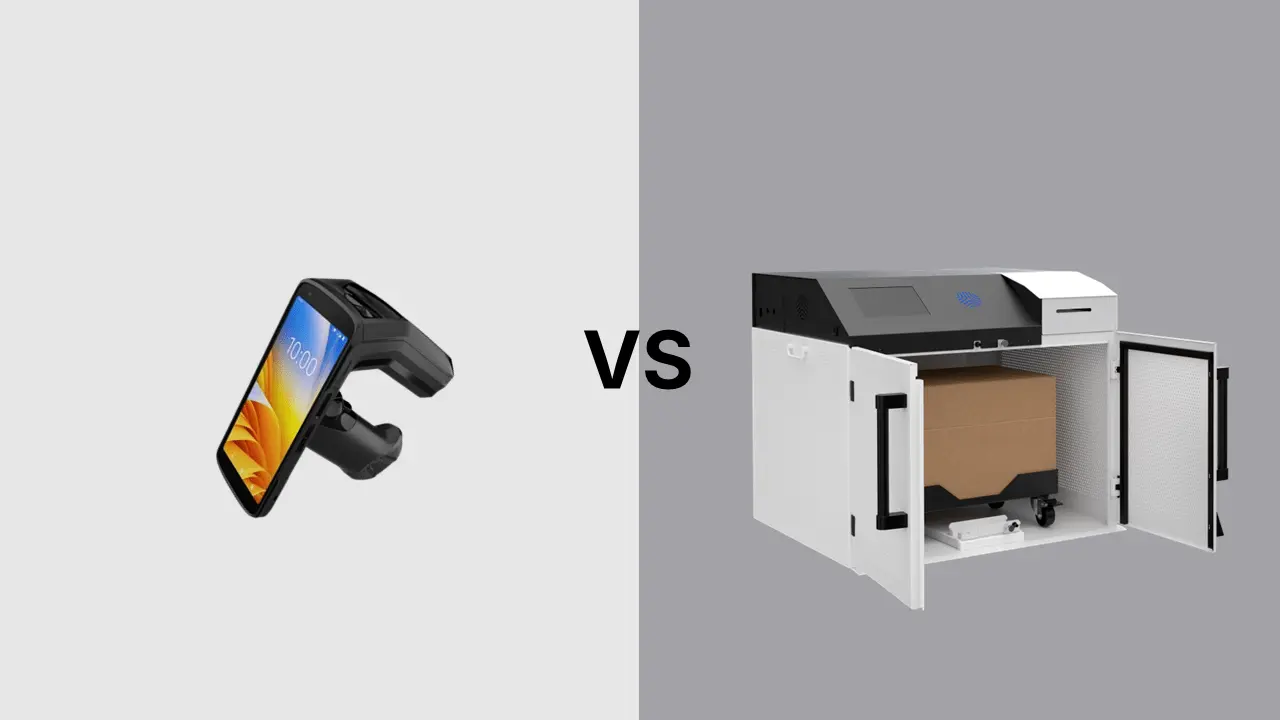
Handheld RFID vs SABI Station
The goal is not to replace handheld readers. Instead, both technologies fulfil different roles within a mature RFID strategy.
| Criteria | Handheld RFID | SABI Station |
|---|---|---|
| Main purpose | Mobility and inventory tasks | Transfer validation and shipment control |
| Reading environment | Open | Controlled with RFID Shield Technology |
| Cross reads | Possible | Virtually eliminated |
| Full-box validation | More operator dependent | Automatic and controlled |
| Validation speed | Variable | Consistent |
| Best use case | Inventory and item location | High-volume transfers and shipments |
Handheld readers provide flexibility. SABI Station provides the level of precision required when every transfer must be validated with confidence.
Business impact of adopting SABI Station
Adding a dedicated RFID validation station delivers benefits that extend beyond faster scanning.
Retailers can achieve:
- Significant reduction in transfer discrepancies.
- Faster validation processes.
- Greater operational consistency.
- Higher productivity during seasonal transitions.
- Lower costs associated with transfer errors.
As a result, store teams can continue using handheld readers for inventory tasks while relying on SABI Station for high-volume transfer validation.
Frequently asked questions about RFID store transfers
Take your RFID transfers to the next level
Retailers that have already adopted RFID have improved inventory visibility. The next step is improving transfer accuracy as operational volumes continue to grow.
At Clustag, we combine RFID, RFID Shield Technology, and Zentup Data Intelligence to help retailers reduce discrepancies, improve inventory accuracy, and gain greater operational control.
We invite you to visit our Customer Experience Center to test these solutions using your own products, or contact our team through our contact form to discover how we can help optimize your transfer operations.