
B2B ecommerce order management is becoming increasingly complex as companies handle larger orders, stricter delivery requirements, and growing customer expectations. Unlike B2C fulfillment, B2B operations demand greater accuracy, complete traceability, and tighter inventory control.
At Clustag, we help businesses optimize fulfillment through RFID-enabled intralogistics solutions. By combining RFID technology, real-time visibility, and intelligent workflows, organizations can reduce errors, accelerate order processing, and improve warehouse performance.
“Our commitment to continuous improvement, excellence, and customer service is stronger than ever. With the effort of our entire team, we will achieve new milestones in ecommerce and consolidate Clustag’s international positioning as a leader in RAIN RFID solutions for complex intralogistics.”
Luis Rius, CEO of Clustag
Why B2B order management is more complex than B2C
Unlike traditional ecommerce, B2B fulfillment involves larger volumes, customer-specific requirements, and significantly lower tolerance for errors. As a result, warehouse operations require greater visibility and control at every stage of the process.B2B fulfillment involves larger volumes, stricter service-level agreements, and customer-specific conditions. Therefore, warehouse operations require greater control and visibility at every stage of the process.
High volumes and low tolerance for errors
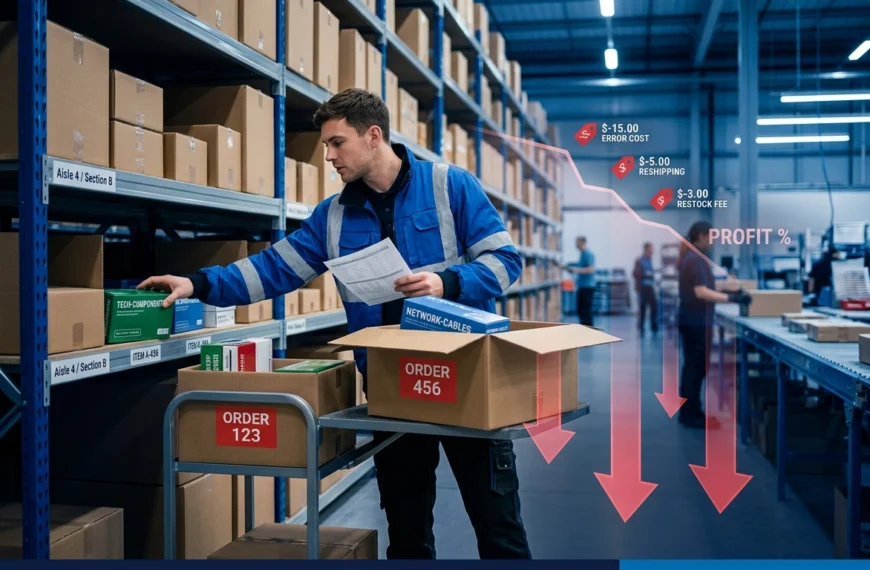
Many B2B orders contain dozens of SKUs and large quantities of products. Consequently, even a small picking error can generate delivery delays, customer complaints, and additional logistics costs.
Customer-specific requirements
In addition, many B2B customers require customized workflows that increase operational complexity, including:
- Customized packaging
- Specific labeling formats
- Batch and lot traceability
- Additional documentation
- Multiple delivery destinations
| Operational factor | B2C ecommerce | B2B ecommerce |
|---|---|---|
| Order size | Small | Large and multi-line |
| Delivery requirements | Standard | Customer-specific |
| Traceability requirements | Moderate | Critical |
| Documentation | Basic | Extensive |
| Error tolerance | Moderate | Very low |
Therefore, businesses need technologies that help manage complexity without increasing manual work.
Common challenges in B2B fulfillment
As operations scale, manual workflows often become a bottleneck. Furthermore, growing order volumes make it increasingly difficult to maintain accuracy and efficiency using traditional processes.As operations scale, manual workflows often become a bottleneck. Consequently, many businesses struggle to maintain accuracy and efficiency.
Picking and verification errors
For example, manual picking processes increase the risk of shipping incorrect products or quantities. Consequently, businesses may face customer disputes, re-shipments, and higher operational costs.Manual picking processes increase the risk of shipping the wrong products or quantities. Furthermore, correcting these mistakes consumes valuable operational resources.
Limited inventory visibility
Meanwhile, a lack of real-time inventory data often leads to:
- Inventory discrepancies
- Stock shortages
- Delayed replenishment
- Inaccurate stock availability
As a result, planning becomes more difficult and customer service levels may suffer.
Returns and customer disputes
When shipment traceability is limited, validating returns and resolving customer claims becomes slower and more expensive. Therefore, many organizations spend valuable time investigating issues that could have been prevented.
How RFID transforms B2B ecommerce order management
Traditional fulfillment processes depend heavily on barcode scans and manual checks. RFID, however, enables automatic identification and validation throughout the workflow.
As a result, businesses can improve speed, accuracy, and visibility simultaneously.RFID enables automatic identification and validation throughout the fulfillment process. As a result, organizations gain greater visibility, accuracy, and operational efficiency.
Automated picking and order verification
When combined with Zentup Workflow, RFID provides operators with real-time guidance during order preparation.When RFID is combined with Zentup Workflow, warehouse operators receive real-time guidance during order preparation.
This helps warehouse teams:
- Validate products at EPC level
- Detect missing items instantly
- Reduce manual verification steps
- Improve picking accuracy
Furthermore, operators can identify errors before orders leave the warehouse.
Real-time inventory visibility
In contrast to traditional barcode-based workflows, RFID continuously captures product movements across the warehouse.
Therefore, inventory information remains accurate and up to date. At the same time, businesses gain better control over stock availability and replenishment planning.
Faster shipment validation
Speed is critical in modern B2B fulfillment operations.
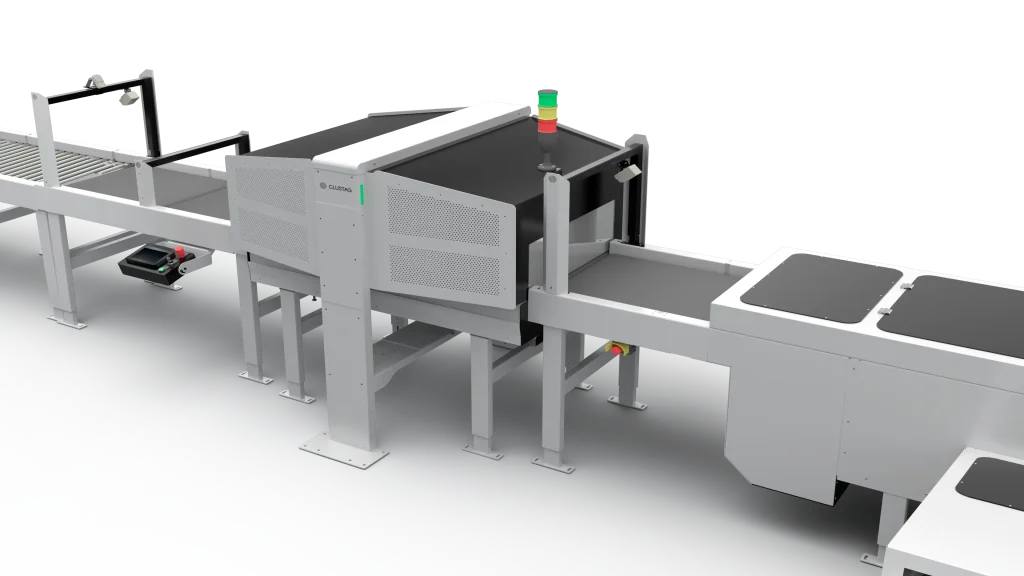
Clustag RFID solutions support processes capable of handling up to 2,000 boxes per hour with a 99.96% RFID read rate. Consequently, organizations can validate shipments faster while maintaining exceptional accuracy.
Clustag RFID solutions for B2B fulfillment
At Clustag, we develop RFID solutions specifically designed to improve productivity while maintaining complete operational visibility.
RFID-enabled workstations and automated labeling
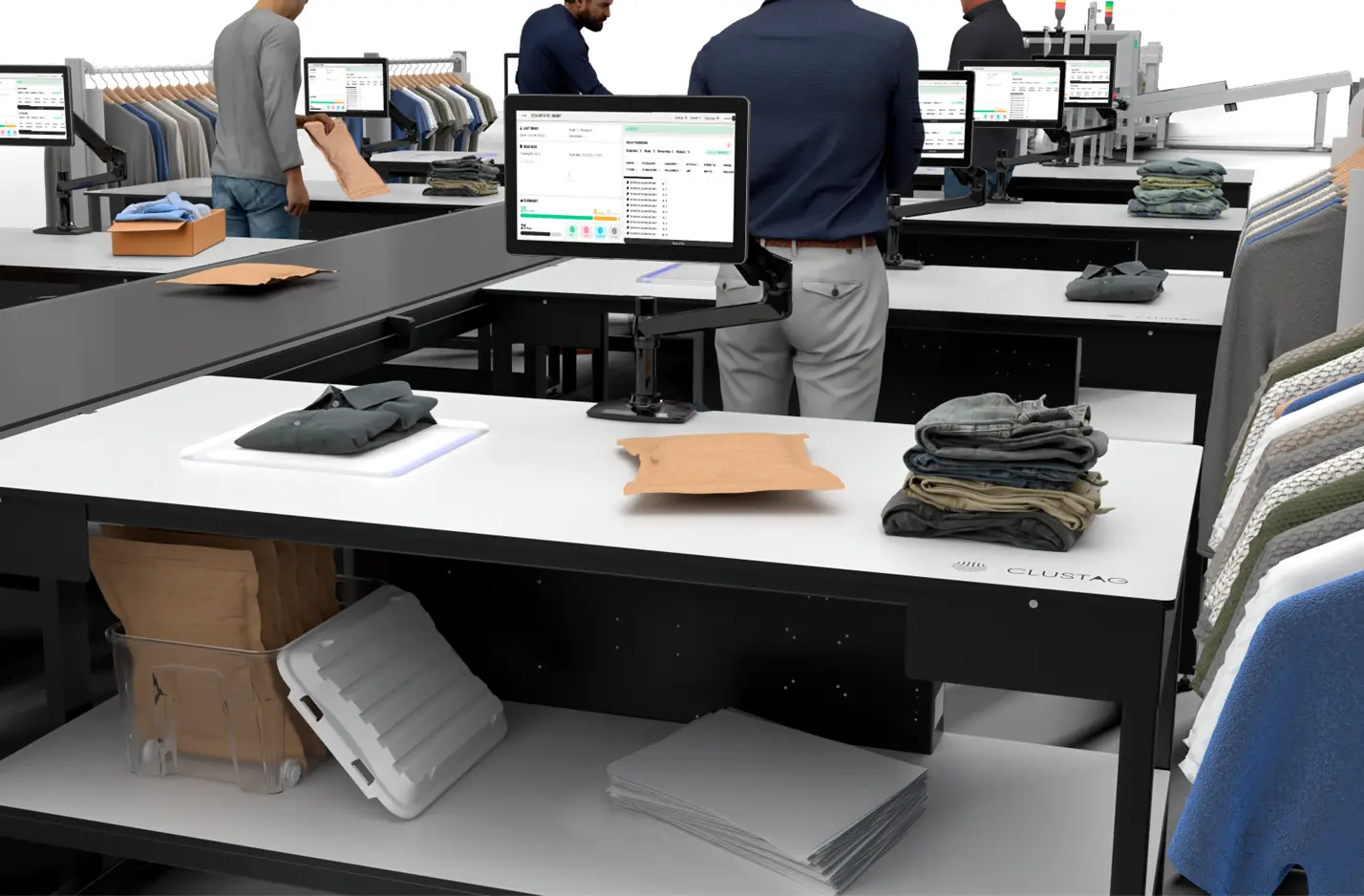
RFID-enabled workstations validate products directly at packing stations. As a result, every shipment is prepared with greater accuracy while reducing manual intervention.
Zentup Workflow for operational assistance
Zentup Workflow provides real-time guidance throughout fulfillment operations.
Therefore, warehouse teams can complete tasks faster and with fewer errors.
RFID Shield Technology
Although RFID delivers exceptional visibility, unwanted reads can affect data quality in dense warehouse environments.
RFID Shield Technology solves this challenge by creating controlled reading zones. Consequently, businesses achieve more reliable validations and higher operational accuracy.RFID Shield Technology creates controlled reading zones that eliminate unwanted reads and improve data accuracy, even in dense warehouse environments.
Integration with ERP, SAP and WMS
Effective fulfillment requires connected systems. For this reason, Clustag solutions integrate seamlessly with ERP, SAP, and WMS platforms.
Learn more about our RFID Solutions.
Business benefits of RFID
The impact of RFID extends beyond faster processing times.
| Business objective | Traditional process | RFID-enabled process |
|---|---|---|
| Picking accuracy | Manual validation | Automated verification |
| Inventory visibility | Periodic updates | Real-time visibility |
| Shipment validation | Manual checks | Automated validation |
| Order traceability | Partial | Item-level traceability |
| Scalability | Limited | High |
In addition, organizations often achieve:
- Higher order accuracy
- Faster fulfillment cycles
- Better inventory control
- Reduced operational costs
- Improved customer satisfaction
Ultimately, RFID does not simply accelerate fulfillment. Instead, it creates a connected environment where inventory, orders, and shipments are continuously validated in real time.
Frequently asked questions about RFID in B2B ecommerce
Experience the Clustag difference
B2B ecommerce operations require speed, accuracy, and complete visibility. With Clustag RFID solutions, businesses can automate order validation, improve inventory accuracy, and achieve end-to-end traceability throughout their fulfillment operations.
If you would like to see our technology in action, visit our Customer Experience Center and discover how RFID can help optimize your warehouse operations.