
Modern facilities need to track the movement of people, vehicles, and goods quickly and accurately. However, manual checks, barcode scans, and traditional access systems often create delays, errors, and limited visibility.
An RFID Portal addresses these challenges by automatically identifying tagged items as they pass through a controlled area, without requiring line of sight or operator intervention. As part of modern RFID solutions, RFID portals help organizations achieve greater accuracy, automation, and real-time visibility across operations.
The Challenge of Controlling Access and Movement
As operations grow, managing the flow of people, vehicles, and assets becomes increasingly complex.
Organizations commonly face:
- Congestion at entry and exit points.
- Manual registration errors.
- Limited traceability.
- Delayed operational processes.
- Reduced visibility of movements.
- Difficulty auditing assets and activities.
These challenges often result in inefficiencies, higher operating costs, and limited operational control.
What Is an RFID Portal?
An RFID Portal is a physical structure equipped with RFID readers and antennas that automatically detect RFID tags moving through a predefined passage point.
Unlike traditional identification technologies, RFID does not require direct visibility between the reader and the tagged item. Multiple tagged assets can be identified simultaneously, even when placed inside cartons, pallets, or moving through the portal.
What Makes RFID Different?
Unlike barcodes and QR codes, RFID technology enables automatic identification without requiring manual scans or direct line of sight. Multiple tags can be read simultaneously, significantly increasing speed and efficiency.
Compared to NFC, which is designed for short-range interactions such as access cards or contactless payments, UHF RFID provides longer reading distances and is better suited for logistics, manufacturing, and asset tracking environments.
As a result, RFID portals allow organizations to automate identification processes while maintaining speed, accuracy, and operational visibility.
How Does an RFID Portal Work?
The process is simple:
- Tagged assets enter the reading zone.
- RFID antennas generate an electromagnetic field.
- RFID tags respond with their unique identifier.
- The reader captures and processes the information.
- Middleware validates the data.
- ERP, WMS, or security systems register the event in real time.
The automated workflow eliminates manual scanning and provides instant visibility of physical movements throughout the facility.
Common RFID Portal Applications
Access Control for People and Vehicles
RFID portals automatically identify employees, visitors, contractors, and vehicles entering or leaving a facility.
Benefits include:
- Faster access validation.
- Improved security and compliance.
- Automated attendance records.
- Reduced waiting times.
Warehouse and Distribution Operations
In logistics environments, RFID portals can automatically verify pallets, cartons, and shipments at receiving and shipping points.
Benefits include:
- Elimination of manual scanning.
- Faster loading and unloading processes.
- Improved inventory accuracy.
- Real-time shipment visibility.
- Reduced shipping errors.
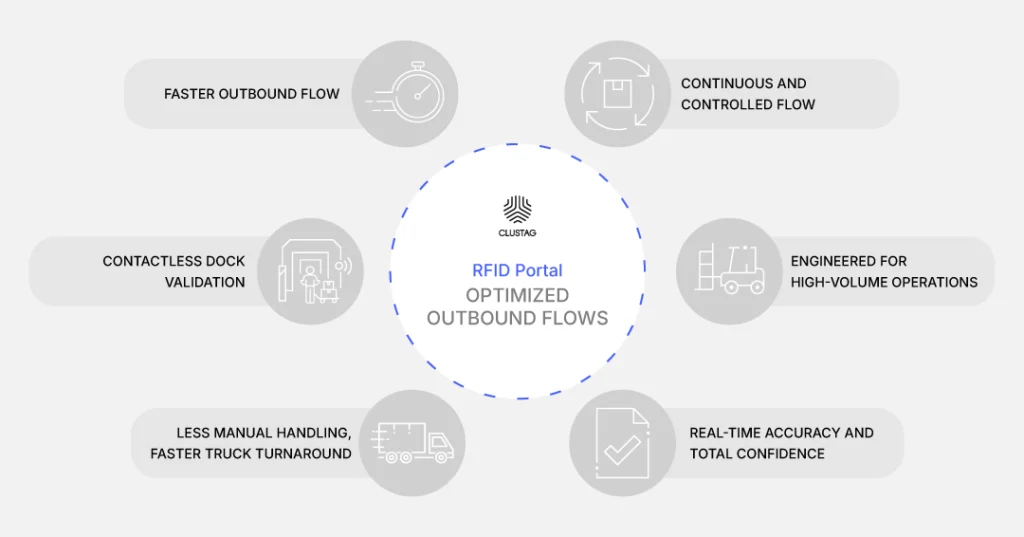
These capabilities are particularly valuable in Outbound Verification processes, where RFID portals validate outgoing shipments automatically and help maintain operational flow.
Manufacturing Traceability
RFID portals can monitor the movement of components and work-in-progress items between production stages.
Benefits include:
- Greater production visibility.
- Improved traceability.
- Reduced process errors.
- Better quality control.

Benefits of RFID Portals
RFID portals help organizations automate identification processes while improving operational efficiency and accuracy.
Traditional Process vs RFID Portal
| Operational Challenge | Traditional Process | RFID Portal |
|---|---|---|
| Verify a pallet before shipping | Manual scanning and visual checks | Automatic validation while pallets are moving |
| Maintain loading speed | Frequent stops and operator intervention | Continuous operational flow |
| Prevent shipping errors | Dependent on manual checks | Automated order verification |
| Handle peak-season volumes | Increased workload and congestion | Scalable performance under high throughput |
| Gain shipment visibility | Delayed or incomplete information | Real-time tracking and status updates |
| Keep trucks moving | Loading dock bottlenecks | Faster turnaround and reduced waiting times |
Key Considerations Before Installing an RFID Portal
Several factors can influence portal performance:
- Metal-rich environments.
- Liquids near the reading area.
- Antenna positioning and configuration.
- RFID tag selection.
- Required reading distance.
- Integration with existing systems.
With proper design, testing, and deployment, these challenges can be effectively addressed to ensure reliable performance and high read accuracy.
Integrating RFID Portals with Business Systems
The value of RFID extends beyond data capture. By integrating RFID portal data with ERP, WMS, security, or manufacturing systems, organizations can automate workflows and gain end-to-end visibility.
At Clustag, RFID events can be integrated with the Zentup RFID Software Platform, transforming raw reads into actionable operational intelligence and real-time decision-making data.
Frequently Asked Questions
Improve Visibility and Control with RFID
Whether your goal is to automate access control, improve warehouse traceability, or streamline outbound verification processes, RFID portals provide a reliable and scalable solution.
Looking to see RFID in action? Visit Clustag’s Customer Experience Center and discover how RFID portals can improve visibility, accuracy, and operational efficiency across your facility.