
Human errors in warehouse operations continue to be one of the biggest causes of inventory discrepancies, shipping mistakes and customer complaints. A misplaced item or an incorrect shipment may seem like a minor issue, but when multiplied across thousands of orders, the operational and financial impact becomes significant.
Human error is not usually a people problem. It is often the result of processes, systems and tools that make mistakes more likely.
Why human errors remain a major warehouse challenge
Warehouse errors can occur at any stage of the operation and often go unnoticed until they affect inventory accuracy or customer deliveries.
Most common warehouse errors
| Error type | Example | Business impact |
|---|---|---|
| Receiving errors | Wrong quantity registered | Inventory discrepancies |
| Picking errors | Incorrect item selected | Returns and complaints |
| Inventory errors | Stock mismatch | Stockouts and overstock |
| Shipping errors | Incorrect order dispatched | Customer dissatisfaction |
Why these errors happen
The most common causes include:
- Manual processes and paper-based workflows.
- Lack of real-time visibility.
- Operational pressure and employee fatigue.
- High SKU volumes.
- Poorly integrated ERP and WMS systems.
A receiving error that goes undetected can eventually become a picking mistake, a shipping issue and ultimately a customer complaint.
The real business impact of warehouse errors
Warehouse errors affect much more than operational accuracy.
| Consequence | Business impact |
|---|---|
| Rework activities | Increased labour costs |
| Shipping mistakes | Additional logistics costs |
| Inventory inaccuracies | Poor planning decisions |
| Customer complaints | Reduced satisfaction and loyalty |
Beyond direct costs, errors reduce productivity and limit a warehouse’s ability to scale efficiently.
Strategies to reduce human errors
Reducing errors requires a combination of process improvement, employee support and technology.
Standardize warehouse workflows
Simpler and more standardized processes make operations easier to execute correctly.
Key actions include:
- Mapping current workflows.
- Eliminating unnecessary steps.
- Defining clear operational procedures.
- Monitoring process performance.
Improve training and verification
Warehouse teams benefit from:
- Continuous training.
- Operational checklists.
- Standard verification procedures.
- Clearly defined responsibilities.
Automate repetitive tasks
Tasks that depend heavily on manual data entry are often the most error-prone.
Automating these activities reduces variability and improves consistency across the operation.
Why RFID reduces human errors more effectively
Traditional identification methods rely heavily on operator intervention. RFID reduces this dependency by automatically capturing and validating inventory information in real time.
How RFID helps eliminate common errors
| Root cause | How RFID helps |
|---|---|
| Manual data entry | Automatic data capture |
| Picking mistakes | Item-level verification |
| Inventory discrepancies | Continuous inventory visibility |
| Shipping errors | Automatic shipment validation |
| Lack of traceability | Real-time tracking |
Unlike barcode systems, RFID can identify multiple items simultaneously without requiring line of sight, making verification faster and more reliable.
Our RFID Solutions integrate with ERP and WMS environments to improve operational visibility and reduce manual intervention.
RFID applications that reduce warehouse errors
Receiving verification
RFID automatically checks incoming goods against expected deliveries, reducing manual validation and receiving errors.
Picking and shipping validation
Our Picking and Packing Solutions verify that the correct products are picked, packed and shipped.
Real-time inventory visibility
By providing continuous inventory updates, RFID reduces discrepancies between physical and digital stock records.
End-to-end traceability
Every product movement can be recorded automatically, making it easier to identify and resolve operational issues.
Real-world success: Nike’s RFID transformation in Eastern Europe
Nike’s exclusive distributor in the Balkans, Sport Time, faced major challenges managing high-volume, diverse inventory across eight countries. Manual post-pick controls, slow item verification, and lack of real-time visibility were leading to frequent errors, shipment mismatches, and operational inefficiencies.
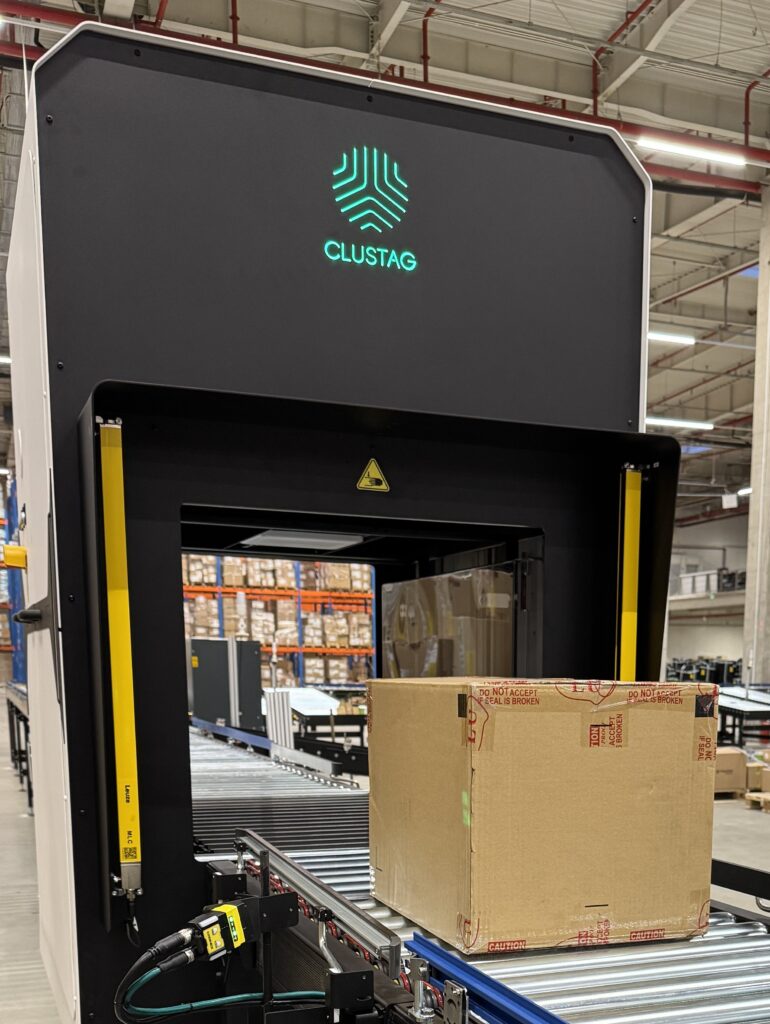
Sport time implemented a fully integrated RFID solutions thanks to Clustag covering:
- Inbound verification: efficient scanning of incoming goods at item levels using RFID.
- Post-pick control: orders packed are instantly verified, with any discrepancies rerouted to audit stations for real-time correction.
- Outbound verification: each shipment validated with RFID before dispatch to ensure accuracy.
- Centralized platform: integration of all warehouse and sport goods operations for visibility and data-driven optimization.
“With RFID, we’re not just talking about process improvement, but about complete transformation. Instead of lengthy and manual receiving processes, we now how have the ability to accurately verify hundreds of items in just a few seconds” – Bojan Djordjevic, Regional MPO and logistics director, Sport-Time
Measurable results
The impact was immediate and transformative:
- 100% item-level accuracy from warehouse to store.
- 66% of retail items tracked with complete traceability.
- Hundreds of items verified in seconds, eliminating lenghty manual scanning.
- 25% reduction in logistics costs by minimizing shrinkage, stockouts, and human errors.
- 35% boost in operational productivity through automation and streamlined workflows.
- 37% faster response times thanks to real-time coordination across inventory systems.
- Enhanced staff efficiency, freeing teams to focus on value-added tasks like customer engagement.
This success story demonstrates how to reduce human errors in a warehouse through digital transformation, combining automation, traceability, and human-centered process design.
Key takeaways
This case highlights how RFID technology can dramatically reduce human error in pick & pack operations, accelerate fulfilment, and provide real-time inventory visibility. Sport Time’s experience demonstrates that implementing advanced digital solutions not only improves accuracy but also transforms operational efficiency and scalability across multi-country logistics networks.
Frequently asked questions
Ready to reduce warehouse errors?
Reducing warehouse errors is not just about avoiding mistakes. It is about increasing productivity, improving inventory accuracy and delivering a better customer experience.
With RFID Solutions, Zentup and RFID Shield Technology, we help organizations build more reliable and efficient warehouse operations.
Visit our Customer Experience Center or complete our contact form to discover how we can help reduce errors across your warehouse operation.