Author: Rafa Villarraso

  • Why In-Situ PoC Testing Is the Smartest Investment Before Deployment

    Why In-Situ PoC Testing Is the Smartest Investment Before Deployment

    Proof of Concept (PoC) validation is one of the most effective ways to reduce risk, avoid unnecessary costs, and ensure a successful project rollout. While laboratory testing and controlled demonstrations provide valuable insights, nothing compares to testing a solution in the real operational environment where it will ultimately be deployed.

    At Clustag, we strongly believe that every RFID, automation, or data intelligence project should be validated under real operating conditions whenever possible. A well-executed PoC allows us to identify limitations, optimize performance, and uncover hidden challenges before significant investments are made.

    The earlier a problem is detected, the lower the cost of fixing it.

    In fact, internal Clustag testing procedures already emphasize the importance of working with real products and real operational conditions during validation stages, ensuring that solutions can be verified before entering production.

    Why PoC testing matters

    A PoC is not simply a technical check. It is a business decision that helps organizations validate assumptions and reduce uncertainty before committing to a full-scale implementation.

    By testing a solution in advance, we can:

    • Verify that the technology performs as expected.
    • Detect environmental factors that could affect performance.
    • Identify operational bottlenecks.
    • Optimize workflows before deployment.
    • Reduce implementation risks.
    • Improve user adoption.
    • Avoid costly redesigns and modifications.

    When technologies such as RFID are involved, real-life conditions often introduce variables that cannot be fully replicated in a laboratory environment.

    PoC testing with real products delivers more reliable results

    Many companies initially test solutions using samples or standard products. While this approach can provide useful indications, it does not always reveal the challenges presented by actual operations.

    Real products may differ in:

    • Packaging materials.
    • Product density.
    • Metal content.
    • Liquid content.
    • Orientation and stacking methods.
    • Storage and transport conditions.

    These variables can significantly impact RFID performance and automation processes.

    This is why we recommend validating solutions using the exact products, containers, pallets, or assets that will be used during daily operations. This methodology is also reflected in Clustag testing plans, which require the availability of real products during validation activities.

    Testing at Clustag versus testing in the real environment

    Our Customer Experience Center is an excellent place to evaluate concepts, demonstrate technologies, and perform initial feasibility studies.

    However, there is a fundamental difference between a controlled environment and a production facility.

    Testing at ClustagTesting in the real environment
    Fast initial validationReal operational validation
    Controlled conditionsReal-world challenges
    Ideal for concept demonstrationIdeal for decision-making
    Simulated product flowsActual product flows
    Limited infrastructure variablesReal infrastructure variables
    Reduced environmental interferenceActual operational interference

    Both approaches provide value, but the highest confidence level is achieved when the PoC is executed under real operating conditions.

    Why real environments reveal hidden risks

    Even when a solution performs perfectly in a controlled setting, unexpected variables may emerge on-site.

    Examples include:

    • Metal structures causing RFID signal reflections.
    • Reader placement limitations.
    • Forklift traffic interference.
    • Unexpected product configurations.
    • Human operational habits.
    • ERP or WMS integration constraints.

    Identifying these factors before deployment allows corrective actions to be implemented while costs are still manageable.
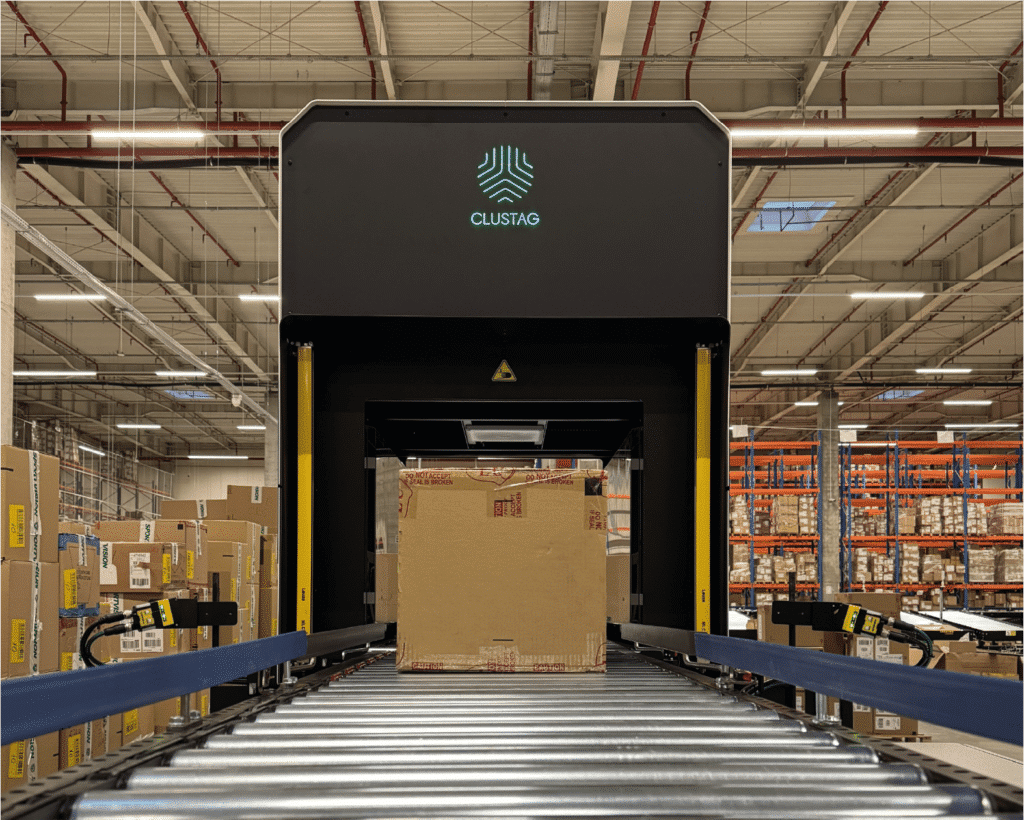
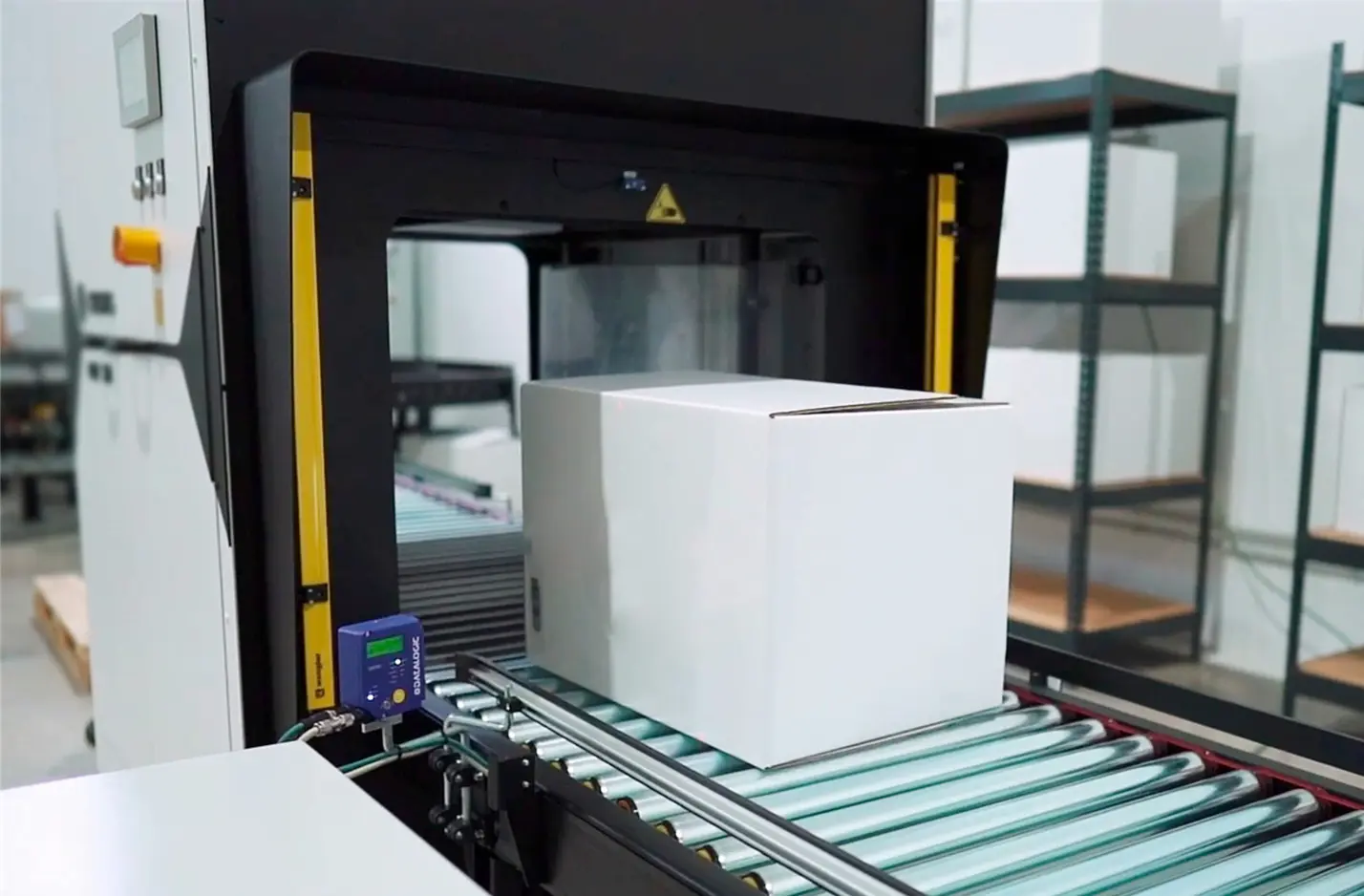
    RFID Tunnel

    How Clustag technologies strengthen the PoC process

    A properly designed PoC can do much more than simply validate reading performance.

    Clustag RFID Solutions validate operational feasibility

    Our RFID systems help organizations confirm that tracking, identification, and automation requirements can be achieved before scaling the project.

    This enables decision-makers to move forward with confidence and clear performance expectations.

    Zentup transforms test data into business intelligence

    During a PoC, massive amounts of operational information can be generated.

    With Zentup, organizations can:

    • Visualize performance indicators.
    • Measure process efficiency.
    • Detect operational anomalies.
    • Compare different test scenarios.
    • Quantify expected improvements.

    Instead of relying on assumptions, decisions can be supported by data.

    RFID Shield Technology eliminates stray-read risks

    One of the most common challenges in RFID environments is the appearance of unwanted reads from nearby products or adjacent operational areas.

    RFID Shield Technology helps mitigate stray reads and creates a more controlled and reliable testing environment, ensuring that PoC results accurately represent the intended process.

    00 in PoC optimization avoids more than €25,000 in post-deployment corrections while accelerating the path to operational success.

    The real value of a PoC

    The true objective of a PoC is not to prove that a solution works.

    The objective is to discover everything that could prevent it from working perfectly before the final implementation begins.

    Organizations that validate projects in real conditions gain:

    • Greater confidence in investment decisions.
    • Faster deployment timelines.
    • Reduced operational risk.
    • Improved ROI.
    • Higher stakeholder acceptance.

    Most importantly, they avoid surprises when the solution enters production.

    If you are evaluating an RFID, automation, or data intelligence project, we invite you to contact our team or visit our Customer Experience Center. Better yet, bring your own products and let us validate the solution together under real operating conditions before your final deployment decision.
  • RFID Tunnel As The First Step Toward Warehouse Automation

    RFID Tunnel As The First Step Toward Warehouse Automation

    An RFID tunnel is one of the most effective ways to bridge the gap between manual warehouse operations and advanced automation. For many operations leaders, the challenge is not whether to automate, but when and how to do it without disrupting performance or overinvesting too early.

    In environments where manual handling still dominates, introducing controlled and scalable automation becomes a strategic decision. The goal is to improve data capture, traceability, and throughput while maintaining operational flexibility.

    The real question is not about adopting automation, but about identifying the indicators that justify it.

    Why manual environments reach their limits

    Before implementing any solution, we need to understand the operational pain points that reveal the need for change. Manual processes can work effectively up to a certain scale, but they eventually show structural limitations.

    Data inconsistencies and lack of real-time visibility

    In manual workflows, data capture depends heavily on operators. Barcode scans, visual checks, or manual inputs introduce variability and errors.

    Typical signals include

    • Mismatches between physical stock and system records
    • Delayed updates in inventory systems
    • Limited traceability across movements

    This lack of reliable data affects decision-making at every level, from daily operations to strategic planning.

    Increasing pressure on throughput and labor

    As volumes grow, manual processes become harder to sustain. Scaling operations often means scaling workforce, which is not always efficient.

    Key indicators include

    • Rising labor costs per processed unit
    • Difficulty maintaining peak productivity
    • Bottlenecks at critical control points

    At this stage, improving efficiency requires more than optimization—it requires introducing automation in a controlled way.

    RFID tunnel as a scalable entry point into automation

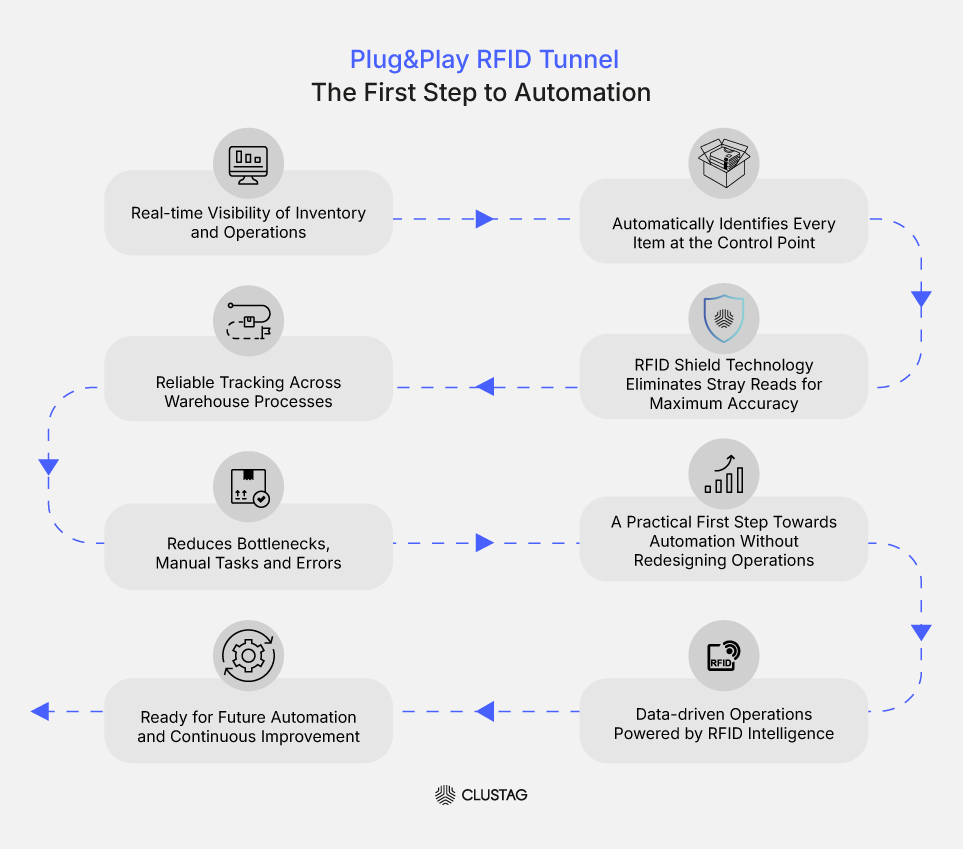
    An RFID tunnel provides a structured and progressive approach to automation. Instead of redesigning the entire warehouse, we introduce automation at key checkpoints where it generates the highest impact.

    Controlled automation without process disruption

    One of the main advantages of semi-automated systems is that they adapt to existing workflows rather than replacing them.

    This allows us to

    • Maintain current operational logic
    • Introduce automation incrementally
    • Minimize resistance to change within teams

    The result is a smoother transition from manual to data-driven operations.

    Consistent and automated data capture

    An RFID tunnel ensures that every item passing through a control point is automatically identified and recorded.

    With solutions like Clustag RFID Systems, we can

    • Eliminate manual scanning errors
    • Capture data in real time
    • Standardize information flows across operations

    This consistency is essential for building reliable analytics and improving overall performance.

    The importance of encapsulation in RFID tunnel performance

    Not all RFID implementations deliver the same results. One critical factor that often determines success or failure is how well the reading environment is controlled.

    Eliminating stray reads and improving accuracy

    Warehouses are complex RF environments, where signals can interfere and produce inaccurate readings.

    A proper encapsulation strategy allows us to

    • Isolate the reading zone
    • Prevent unwanted tag detection
    • Improve read precision

    This is where RFID Shield Technology becomes essential, ensuring that the tunnel reads exactly what it should, and nothing more.

    Building trust in operational data

    When data is inconsistent, teams stop relying on it. A well-encapsulated RFID tunnel guarantees stable performance and builds confidence across the organization.

    This leads to

    • Better operational decisions
    • Higher adoption of technology
    • Stronger alignment between systems and reality

    Turning RFID tunnel data into operational intelligence

    The value of an RFID tunnel goes beyond identification. It becomes a powerful source of data that can transform how warehouses operate.

    From raw reads to meaningful insights

    Capturing data is only the first step. Processing and structuring it is what creates value.

    With Zentup data intelligence, we can

    • Convert raw reads into actionable events
    • Visualize flows in real time
    • Detect inefficiencies and process deviations

    Enabling future automation strategies

    Reliable data is the foundation for more advanced initiatives. Once an RFID tunnel is in place, it becomes easier to evolve toward higher levels of automation.

    This includes

    • Predictive process optimization
    • Integration with automated systems
    • Continuous improvement based on real data

    Comparing manual processes and RFID tunnel implementation

    To support decision-making, it is essential to compare current operations with a semi-automated approach.

    Operational factorManual environmentRFID tunnel approach
    Data accuracyOperator-dependentAutomated and consistent
    TraceabilityPartial and delayedReal-time visibility
    ThroughputLimited by laborIncreased without major changes
    ScalabilityComplex and costlyProgressive and controlled
    ReliabilityVariableStable and predictable

    This comparison helps operations directors quantify the impact and justify the transition based on measurable improvements.

    When an RFID tunnel becomes the right decision

    Not every warehouse needs full automation, but many reach a point where manual processes are no longer enough.

    The right moment typically arrives when

    • Data errors start impacting business outcomes
    • Labor costs scale faster than productivity
    • Traceability becomes a critical requirement

    At this stage, an RFID tunnel is not just an improvement—it is a strategic step forward.

    From operational challenge to practical solution

    Once these indicators are clear, the next step is choosing a solution that combines performance, ease of implementation, and scalability.

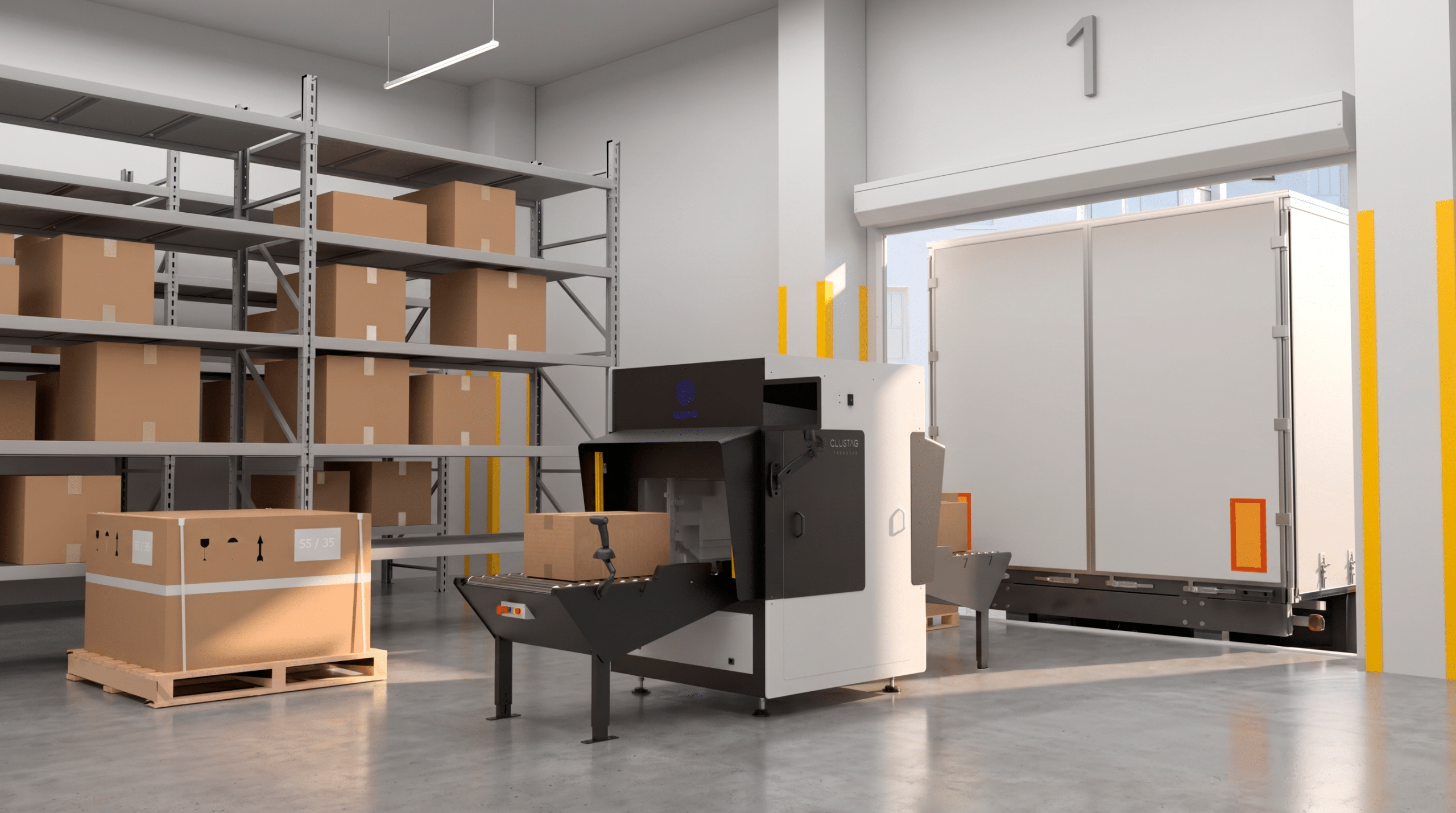
    Solutions like the MOT Lite A34 represent this approach, offering

    • Plug-and-play deployment to reduce implementation time
    • Controlled RFID environments with proper encapsulation
    • Reliable data capture ready to be integrated into existing systems

    If you want to explore how this type of solution can fit your operation, we invite you to discover the MOT Lite solution and evaluate its potential in your environment.

    The most effective path to automation starts with control, visibility, and the ability to scale at your own pace.

    We also recommend visiting our Customer Experience Center to test these solutions with your own products or contacting our team to assess your specific use case.

  • Clustag at CeMAT Australia 2026 Strengthening Global Intralogistics Innovation

    Clustag at CeMAT Australia 2026 Strengthening Global Intralogistics Innovation

    Clustag at CeMAT Australia 2026 and why global presence matters

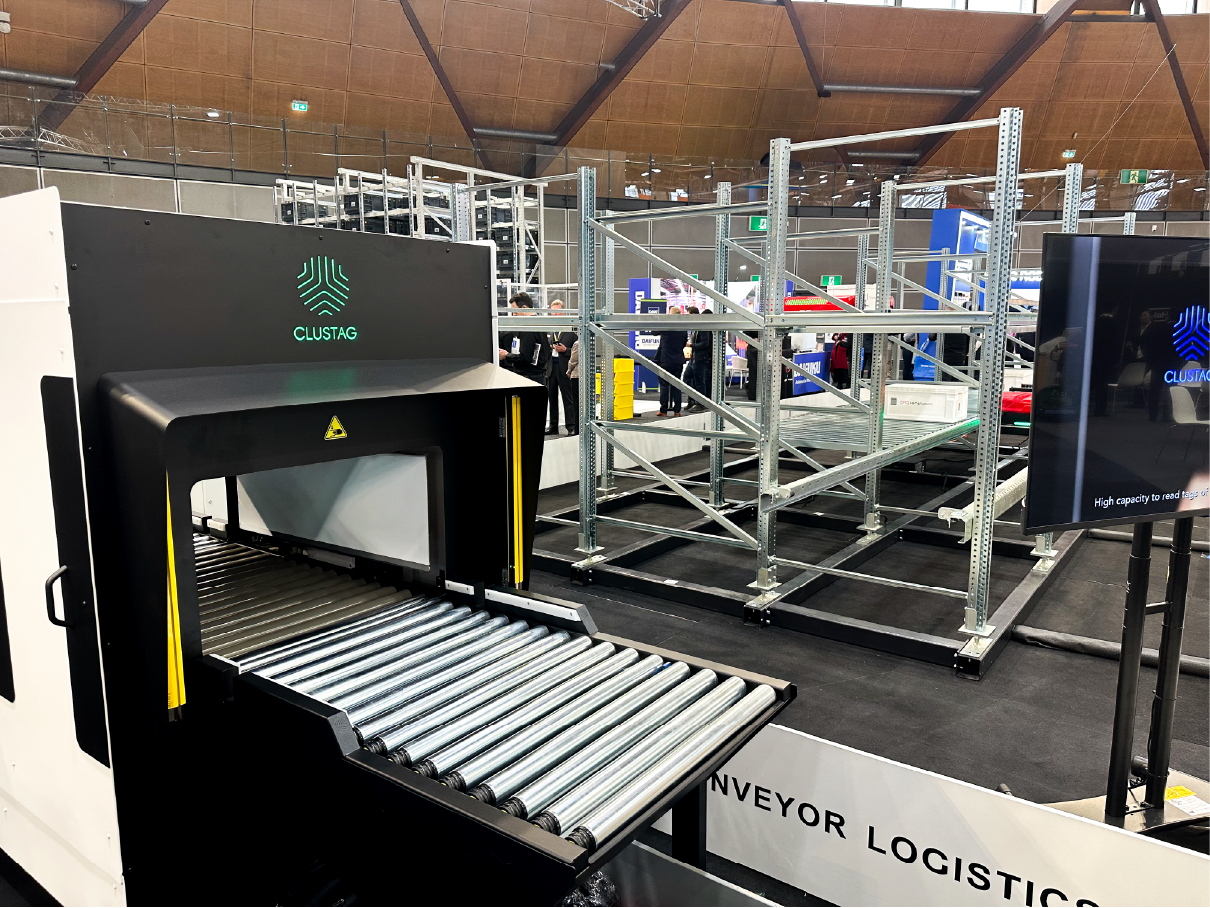
    Clustag at CeMAT Australia 2026 represents a key milestone in our global expansion strategy and reinforces our commitment to bringing cutting-edge RFID Solutions to the most demanding supply chain environments worldwide. From June 23 to 25, we will be present at one of the most important intralogistics and automation events in the Asia-Pacific region, a hub where innovation, operational excellence, and digital transformation converge.

    As a global company, being present at CeMAT Australia is more than attending a trade show. It is about actively contributing to the evolution of logistics ecosystems across continents. Australia’s market is rapidly adopting advanced automation technologies, making it a strategic location to showcase how our solutions can help companies scale efficiently, reduce operational inefficiencies, and gain real-time visibility across their operations.

    Our participation alongside our trusted partner Conveyor Logistics highlights the importance of collaboration in delivering end-to-end solutions. By combining their expertise in material handling systems with our RFID technology, we are enabling a seamless integration of tracking capabilities into complex industrial environments.

    Real-time visibility is no longer a competitive advantage; it is a requirement for companies aiming to lead in modern intralogistics.

    MOT Lite A34 advantages and scalable RFID applications

    At the heart of our presence at CeMAT Australia 2026 is the MOT Lite (A34), a compact yet powerful device designed to deliver high-performance RFID tracking in a wide range of scenarios. This solution represents the perfect balance between flexibility, efficiency, and ease of deployment.

    The MOT Lite is specifically engineered to support companies that require scalable tracking solutions without the complexity of large installations. Its versatility makes it ideal for both pilot projects and full-scale deployments across logistics and industrial operations.

    Key benefits of MOT Lite A34

    The MOT Lite brings a set of capabilities that directly address the most common operational challenges faced by logistics and operations leaders:

    • Quick and simple deployment
      Its compact design allows for rapid installation without major infrastructure changes.
    • High read accuracy
      Thanks to our RFID Shield Technology, it minimizes stray reads and ensures precise data capture even in dense environments.
    • Seamless integration
      It connects effortlessly with Zentup, our data intelligence platform, enabling real-time analytics and reporting.
    • Cost-efficient scalability
      Ideal for companies starting their digitalization journey or expanding existing RFID systems.

    Typical use cases for MOT Lite

    The flexibility of the MOT Lite allows it to be deployed across multiple operational scenarios, including:

    • Monitoring asset movements in warehouses and distribution centers
    • Managing returns and reverse logistics processes
    • Controlling workflows in manufacturing environments

    These use cases highlight how businesses can achieve significant efficiency gains by adopting lightweight yet powerful RFID solutions.

    Problems and solutions enabled by Clustag technology

    Operational challengeClustag solution with MOT Lite A34Resulting benefit
    Lack of real-time visibilityRFID tracking integrated with ZentupInstant access to operational data
    Inaccurate reads in complex environmentsRFID Shield TechnologyHigher precision and reduced errors
    High deployment complexityPlug-and-play MOT Lite architectureFaster implementation and lower costs
    Limited scalabilityModular and flexible RFID infrastructureEasy expansion as operations grow

    By combining hardware, software, and advanced signal control, Clustag delivers a comprehensive ecosystem that adapts to each client’s operational needs.

    Visit stand K31 and experience real innovation

    Our participation would not be complete without a hands-on experience. That is why we invite all attendees to visit the Conveyor Logistics stand K31, where the MOT Lite A34 will be showcased in a real operational context.

    At the stand, visitors will have the opportunity to:

    • Understand how data flows from devices to Zentup for real-time decision-making
    • Explore how RFID Shield Technology ensures reliable performance
    • Discuss specific use cases with our team and our partner experts

    This is a unique opportunity to experience how Clustag solutions can be applied directly to real-world challenges and to discover how companies across industries are already benefiting from improved efficiency, accuracy, and control.

    For organizations looking to accelerate their digital transformation, CeMAT Australia 2026 is the perfect place to start meaningful conversations and identify the right technology partners.

    We encourage logistics, operations, and innovation leaders to stop by stand K31 and explore how we can help them unlock the full potential of their supply chain operations. Additionally, we invite you to reach out through our contact form or visit our Customer Experience Center to test our solutions using your own products and validate their impact in a controlled environment.